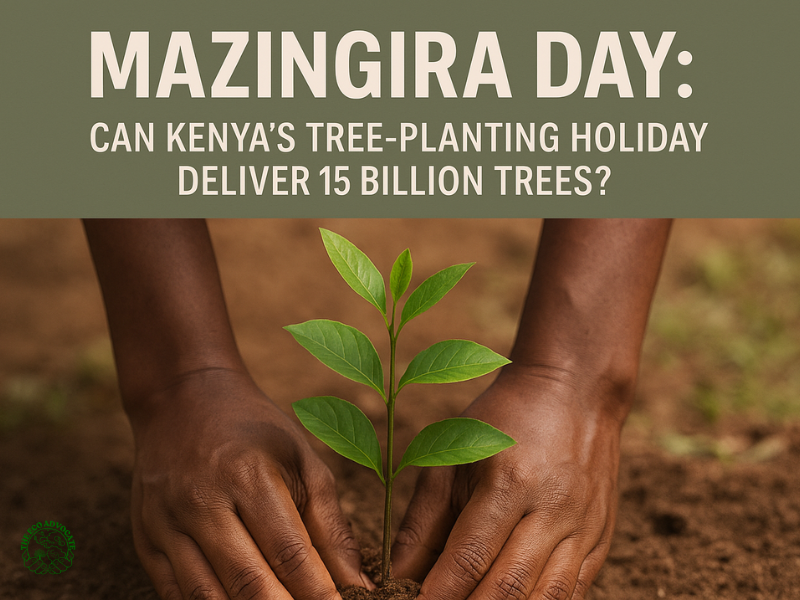
On 10th October 2024, Kenya renamed Utamaduni Day to Mazingira Day, a public holiday dedicated to the environment. For the first time in Africa, a country is giving its citizens a day off work specifically to plant trees and clean up ecosystems. It follows two earlier national tree-planting holidays: 13th November 2023, when about 150 million seedlings were reported to have been distributed nationwide, and 10th May 2024, which targeted one billion plantings in a single day. These holidays are part of the government’s audacious plan to plant 15 billion trees by 2032.
It’s a bold vision, but a key question hangs over it: are we planting trees, or are we actually growing forests?
Kenya’s Tree-Planting Blitz
The scale of the campaign is impressive. By April 2025, official figures showed about 783 million seedlings planted, with President Ruto claiming 750 million of those in 2024 alone (Lots of questions raised on this). The aim is to lift Kenya’s tree cover to 30% of land area, from the 7–12% currently recorded.
Mazingira Day has become the anchor of this campaign, not a day for parades, but for practical action. Cabinet secretaries are dispatched across the 47 counties to lead planting, schools, and chiefs’ offices distribute free seedlings, and community members turn out in the thousands. The symbolism is strong: Kenya is signalling that climate action is everyone’s business.
But symbolism does not guarantee success. Planting 15 billion trees means 1.5 billion every year for a decade, or roughly 4 million every day. That requires not only seedlings in the ground but also survival, monitoring and a cultural shift that makes tree care routine.
The Survival Question: From Planting to Growing
Kenya’s environmentalists have long warned: “Tree planting is just the beginning.” The harder work is ensuring seedlings survive their first few years. Without watering, weeding or protection from grazing animals, mortality can exceed 70% in some regions.
Global studies show the challenge clearly. On average, 18% of saplings die in the first year, and around 44% are gone within five years in tropical reforestation projects. Kenya is no exception. In semi-arid counties, survival rates can drop below 30% if trees are left unattended.
Some initiatives show better outcomes. The chiefs-led monthly planting program, where every local chief mobilises their community to plant and maintain trees, recorded a 60% survival rate for 6.4 million seedlings in its first year. It worked because the trees were followed up: watered, guarded and integrated into local routines.
This distinction between planting and growing will determine whether Mazingira Day is remembered as a breakthrough or a missed opportunity.
Monitoring and Technology
To avoid repeating the mistakes of past campaigns, the government has rolled out digital tracking. The JazaMiti mobile app allows Kenyans to record planted trees by species, location, and number, even uploading photos. The app is meant to shift focus from counting seedlings distributed to tracking which ones survive and thrive.
NGOs are also experimenting with monitoring. One Acre Fund’s Tupande program uses digital tagging and farmer surveys to check survival rates months after distribution. This data helps identify which species perform best in which areas.
However, uptake of these tools is uneven. Many rural communities lack smartphones or data access. Without strong grassroots integration, high-tech monitoring risks becoming a reporting exercise for donors rather than a real feedback loop for farmers and citizens.
Funding and Policy Gaps
Another challenge is money. The Kenya Institute for Public Policy Research and Analysis (KIPPRA) estimates the campaign will need about KES 60 billion annually (≈ USD 400 million). Yet government allocations have been far smaller – KES 10.15 billion in 2022/23 and KES 14.3 billion in 2023/24. That leaves a yawning gap that must be filled by private sector contributions, county budgets and international climate finance.
Policy consistency is also under scrutiny. In 2023, President Ruto lifted a six-year ban on logging of mature forests. Officials argue that only over-mature plantation trees are being harvested, but civil society fears this undermines the gains of new planting. The optics of cutting trees while calling for 15 billion new ones make citizens sceptical. If Mazingira Day is to succeed, protection of existing forests must match the planting of new ones.
Community Ownership: The Deciding Factor
Top-down campaigns have limits. The real drivers of tree survival are local communities. Where people see direct benefits, trees thrive. That is why the government’s recent pivot to fruit trees is smart: in Mazingira Day 2025, 71 million of the targeted 100 million seedlings are fruit trees to be planted in schools. A mango or avocado tree is not just carbon storage; it is food, income and shade. Farmers and students are far more likely to water and protect such trees.
Similarly, indigenous species like acacias in drylands or African olives in highlands tend to survive better and restore ecosystems more effectively than exotic species. Communities with a say in species choice are more motivated to nurture them.
Kenya can also learn from Rwanda’s Umuganda days, where citizens come together monthly for community service. Making tree growing a regular, communal duty, not just a once-a-year holiday, could embed it in social culture.
How Do We Do It Better?
For Kenya to turn Mazingira Day from spectacle to success, several evidence-based steps are essential:
- Shift Metrics – Stop celebrating only seedlings planted. Publish survival rates, canopy cover gains and reforested hectares.
- Guarantee Follow-Up – Link each planting site to a responsible community, school or institution for at least two years of care.
- Invest in Watering Systems – Promote rainwater harvesting, drip irrigation, or low-cost “water box” technologies for dry areas.
- Empower Local Leaders – Scale up the chiefs’ monthly tree programs and reward villages with the best survival rates.
- Protect Existing Forests – Planting must go hand-in-hand with halting deforestation and regulating logging.
- Close the Funding Gap – Leverage climate finance, green bonds, and corporate partnerships to mobilise the billions needed.
- Prioritise Indigenous and Fruit Trees – Plant species that offer ecological and economic value to ensure community ownership.
- Transparency and Accountability – Independent audits of progress will keep the campaign honest and adaptive.
Beyond the Holiday
Declaring a national holiday for the environment was a bold and globally unique move. It showed leadership and urgency. But the success of Mazingira Day and Kenya’s 15-billion-tree vision will not be measured in press releases or ceremonial photos. It will be measured in living forests, in cooler microclimates, in rivers restored and in communities that see trees as part of their future prosperity.