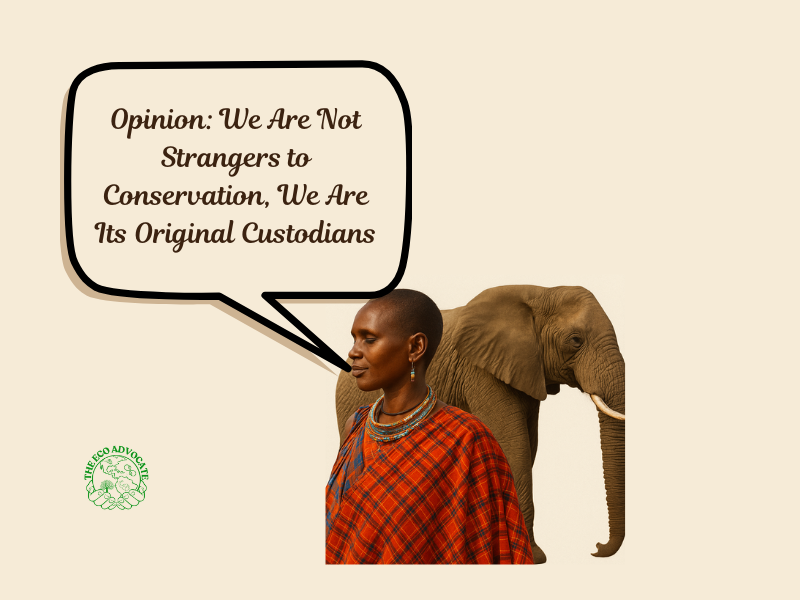
I recently came across a video where the speaker framed African local communities as distant from wildlife conservation, as though we need to be taught how to care for the very animals we’ve shared our land with for generations.
That narrative felt familiar, and not in a good way. It echoes the old, persistent story where conservation is seen as something brought to us, rather than something that has always existed among us.
A Shared History
In Kenya and across Africa, wildlife doesn’t live in isolation. Over 70% of wildlife in Kenya lives outside protected areas, in landscapes shared with local communities. These are not just spaces, they are homes, grazing lands, sacred sites, and migration corridors.
Our cultures don’t view wildlife as resources to be managed. We see them as beings with meaning. In many communities, specific animals are clan totems. Forests are sacred. Hunting is bound by taboos and traditions that have sustained balance far longer than modern conservation ever has.
Before there were parks, there were stories, songs, and spiritual practices that protected the land.
Conservation Isn’t New to Us, But the Displacement Is
What is newer is the idea that protecting nature requires fences, guns, and eviction. In too many places, conservation has arrived hand in hand with displacement.
The Maasai were moved for the parks. The Ogiek were evicted from their ancestral forests. Communities near Amboseli and Tsavo live daily with the challenges of human-wildlife conflict, yet are rarely in the room where policy is made.
What’s even more troubling is when those who have benefited most from this system turn around and frame us as the problem.
We’ve Given Our Culture for Free, and Still Get Questioned
Tourism in Kenya thrives not just on wildlife, but on culture. Visitors know “jambo,” they eat nyama choma, they wear Maasai shukas and buy beaded art. They take a piece of our identity home, often without paying for it.
And yet, the same people can speak about us as though we need to be “included” in conservation, as if we’re not already doing the work, holding the weight.
We’ve always shown up for wildlife, tourists, and the land. But when we speak about how we see conservation, we’re too often overlooked or worse, silenced.
It’s Time to Shift the Narrative
We are not conservation’s beneficiaries; we are its backbone.
We don’t need saving, we need recognition, respect, and representation.
We must stop framing African communities as passive, problematic, or in need of conservation “education.” Instead, let’s amplify models where:
- Communities own conservation outcomes,
- Indigenous knowledge guides ecological decisions,
- And funding flows to those protecting wildlife long before it was profitable.
Let’s Reclaim the Story
Conservation doesn’t need a saviour complex. It requires a partnership. And it starts with listening to those whose footprints are already on the land.
Let’s tell that story, boldly, truthfully, and from the ground up.