
Ask a teenager from Kayole, or Dandora, or Kibera, or Pipeline what they know about Nairobi National Park, and here is what you will likely get. A lion, mid-roar, set against a skyline of glass towers, the image that shows up on every tourism poster and half the Instagram reels shot in the city. Maybe a fact picked up in a primary school textbook: the only park in the world inside a capital city. Maybe a vague sense of pride, the kind you feel about something that belongs to your country in theory, without ever quite belonging to you in practice.
Now ask that same teenager when they last actually walked through the gate.
For a striking number of young Nairobians, the honest answer is never. Not once. Despite living, in some cases, closer to Nairobi National Park than they live to their own secondary school, an entire generation is growing up experiencing “their” park almost entirely secondhand, through advertising, through a class trip that may or may not have happened, through a photo a wealthier relative posted from a weekend safari. This essay asks why that gap exists, what the research says actually closes it, and what it produces when it stays open: a kind of wildlife pride that is all aesthetic and no relationship, admiration with nothing asked of it in return.
A mental image built from everywhere except the park itself
Picture a specific, plausible young Nairobian: seventeen years old, finishing secondary school, has grown up her whole life within an hour’s matatu ride of Nairobi National Park’s Main Gate. She knows the park exists the way she knows Mount Kenya exists, as a fact about her country rather than a place she has been. Her image of it comes from a handful of sources, none of them the park itself: a KWS advertisement on a billboard along Langata Road, a wildlife documentary clip shared in a WhatsApp group, a school textbook page, and the safari photos of a cousin whose family could afford a guided half-day tour for a birthday.
None of those sources are false, exactly. But none of them are a relationship either. She has absorbed the idea that the park matters, that it is a source of national pride, that lions and rhinos are precious and worth protecting. What she has not absorbed is any felt, personal stake in that protection, because she has never stood inside the fence and had her own encounter to measure the postcard against. This is not a hypothetical problem invented for the sake of a tidy opening scene. It is a pattern researchers studying youth conservation attitudes in Kenya have documented directly, and the mechanism behind it turns out to be fairly well understood.
What actually builds a relationship with wildlife, and what erodes it
The clearest empirical study on this question, still cited more than fifteen years after it was published, comes from John Kioko, John Warui Kiringe, and Geff Wahungu’s 2010 research on youth knowledge, attitudes, and practices around wildlife conservation in Maasailand, published in the Southern African Journal of Environmental Education. The researchers surveyed a stratified sample of students, along with informally educated Maasai morans, across communities near Amboseli National Park, and their findings map closely onto what this essay is trying to understand about Nairobi.
Two factors stood out as the strongest predictors of a young person having a genuinely engaged relationship with wildlife, rather than a merely abstract one. The first was direct exposure: schooling itself, and specifically participation in extracurricular wildlife or environmental clubs, positively and measurably shaped how young people perceived conservation. Among the students surveyed, 59.2 percent were already members of some kind of wildlife or environmental club, and club members showed markedly higher rates of having actually visited a protected area than non-members, roughly 45 to 46 percent of upper primary club members compared to about 31 percent of non-members. The second predictor was even more specific: youth whose own parents were engaged in tourism-related work showed measurably more positive attitudes toward wildlife than youth whose families were not, evidence, the study’s authors argued, that economic proximity to the value wildlife generates translates directly into a young person’s sense that conservation matters to their own life, not just to some abstract national interest.
What erodes that connection, meanwhile, is precisely the set of pressures the rest of this series has already documented: urbanisation, land subdivision, and the steadily rising cost of simply getting through a park gate. A young person whose family has been pushed off pastoral land by subdivision in Kitengela, or who has moved from a wildlife-adjacent rural community into Nairobi’s expanding urban edge, loses the daily, ambient exposure to wildlife that once shaped their sense of what the animals were and why they mattered. For Nairobi specifically, that erosion takes a mostly economic form. It is not that the park has become physically less accessible in the way Kitengela’s grazing land has become fenced. It is that the entry fee, discussed in Essay 1, along with the added cost of a vehicle, a guide, and transport to the gate, puts a “free” city landmark just out of easy reach for a family already stretching a modest income across rent, school fees, and food.
Wildlife Clubs of Kenya, and the fifty-year-old proof that this gap is addressable
If all of that sounds like a slow, structural inevitability, one more fact should complicate that picture, because Kenya has already run a fifty-plus year experiment proving the opposite is possible.
In December 1968, a group of students at Kagumo High School in Nyeri approached their teacher with a specific complaint: national park entrance fees were too expensive for ordinary local people to afford, which meant most Kenyans were not visiting the very parks their country was becoming internationally famous for. Their teacher took the complaint to Kenya’s Ministry of Tourism and Wildlife, which brought in the African Wildlife Foundation to help design a response. What emerged, remarkably quickly, was the Wildlife Clubs of Kenya, the first conservation education movement of its kind on the entire African continent, built explicitly around the idea that free or subsidised park access, paired with structured environmental education, could build the relationship a postcard alone never would.
It worked, at least by the measure of scale. By 1979, just over a decade after that first letter, Kenya had 439 registered Wildlife Clubs with a combined membership of roughly 20,000 students, recognised by the United Nations Environment Programme’s Global 500 Honour Roll as the most effective grassroots conservation programme of its kind in Africa, and the movement went on to directly inspire similar wildlife club movements in Uganda, Tanzania, the Seychelles, Botswana, Nigeria, and India. Wildlife Clubs of Kenya remains active today, continuing to run school and institutional memberships across the country, and its core mechanism has barely changed in fifty-plus years: structured environmental education paired, wherever possible, with the chance for members to actually enter a park and see the wildlife they are being taught to value. A 2017 study confirmed that participation in structured club activities was still strongly associated with more positive attitudes toward wildlife conservation among secondary school students, evidence the model is not a one-off historical accident but a durable, replicable pattern. As recently as 2024 and 2025, the African Wildlife Foundation and Wildlife Clubs of Kenya launched a four-year conservation education partnership in the Tsavo landscape, aiming to reach approximately 83,000 learners across 137 schools, evidence that the model is still considered worth scaling rather than a relic of a different era.
What this history proves, plainly, is that the disconnect this essay is describing in Nairobi is not some fixed, permanent feature of urban life. It is a policy choice, or more precisely, the absence of one, applied to the one park with the country’s largest concentration of young people living around it. Kenya has already demonstrated, at national scale, that youth disconnection from wildlife is addressable through the unglamorous combination of subsidised access and structured education. The tools exist. The question is why a park seven kilometres from the country’s capital is not the single most obvious place to apply them at full strength.
A Saturday that proves the mechanism
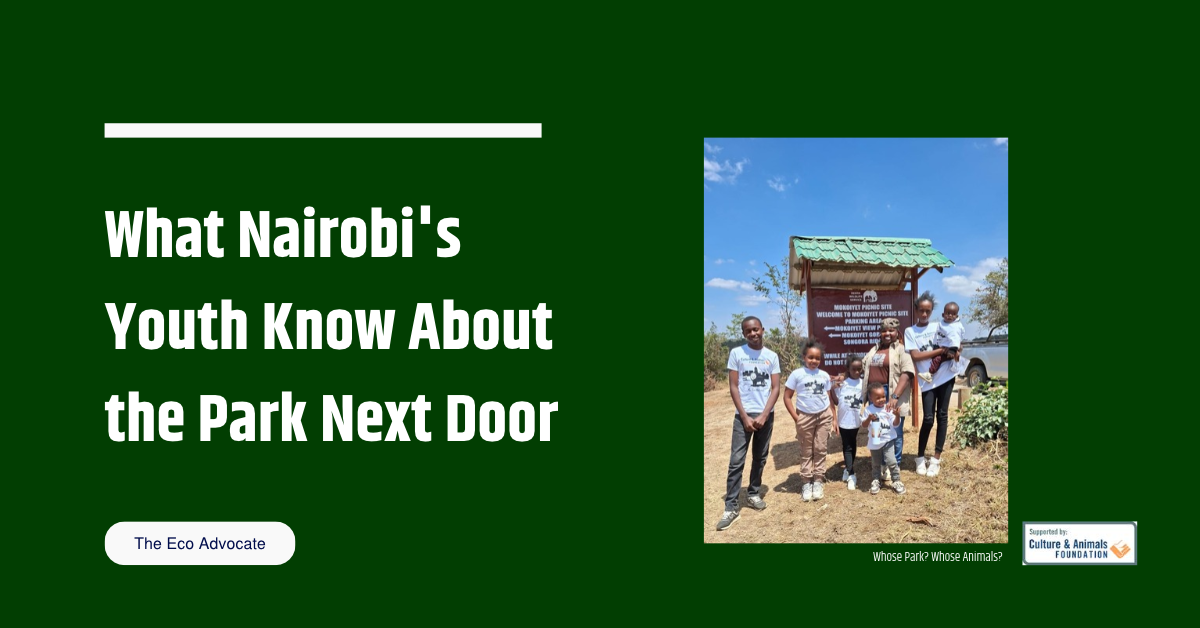
The clearest evidence for this essay’s argument came, unexpectedly, from this project’s own fieldwork rather than from a survey question. On September 27, 2026, this series organised a game drive at Nairobi National Park for children from Pipeline estate and Kangundo, several of them entering the park for the first time in their lives.
What happened over the following five hours looked exactly like the mechanism Kioko, Kiringe and Wahungu’s research predicts, playing out in real time. The driver-guide leading the trip abandoned the traditional lecture format almost immediately, once he noticed the kids were more comfortable asking questions than listening to a script, and let their curiosity set the pace instead. The kids did not just absorb facts, they visibly retained and reused them: told that zebras can be told apart partly by their black hooves and noses, one child connected this, unprompted, thirty minutes later, to a donkey she knew from home, asking whether donkeys were secretly zebras too. That is not passive sightseeing. That is a child actively building a relationship to the animal by testing it against what she already knew.
The retention showed up again afterward, in an unplanned way, in a post-drive drawing session: kids picked pages from a drawing book that matched what had actually struck them that day, not generic animal pictures. One child, who said she wants to work at KWS, chose a page showing a vet treating a leopard. Another drew herself, quite literally, watching animals from inside a tour van, the exact experience she had just had. A three-year-old on the trip, on his first-ever real-life animal encounter, drew a bright pink leopard and sang through the entire session, fully absorbed, a reaction his father described as part of what convinced him to keep bringing his children back. That reaction from a three-year-old is, in miniature, the entire argument of Wildlife Clubs of Kenya’s 1968 founding logic: give a child direct exposure, and something durable forms that a billboard never could.
That father was Dennis, the same parent quoted in Essay 1 recalling his own first visit to the park back in 1993. His son’s reaction to this one, he said, was just as immediate and unguarded: genuinely excited, shouting out to his father at more than one sighting, in what was the boy’s first real encounter with any of these animals outside a screen. Dennis’s own conclusion from the day was broader still. He told us he now actively encourages other parents to bring their children to the park, on the grounds that kids learn about native animals in a way no classroom or documentary fully replicates, and that this kind of local knowledge, built firsthand rather than inherited secondhand, is exactly the thing worth passing on.
A second Pipeline parent, Naomi, wrote up her own account afterward and arrived at the same mechanism from a different angle entirely: not ownership or ambassadorship, but the gap between a textbook and a body. “In class they read about the ‘Big Five’ and ecosystem,” she wrote, “but here they could see it, smell it and also feel it.” She described watching her children’s excitement shade into a little fear as a lion came into view, and using that moment to teach them about respecting wildlife and staying safe, rather than treating the fear as something to manage away. The day also gave her a natural opening to explain, on the spot, why the family doesn’t litter and doesn’t feed the animals, conservation taught as something lived rather than recited. Her own verdict matched Dennis’s almost exactly: not sightseeing, but “bonding, learning and creating memories that will last,” in one of the only places on earth where wildlife and a capital city exist side by side.
The tour guide leading the drive made the same point from the other side of the windscreen. He described kids as consistently the most eager, curious visitors he guides, asking real questions rather than performing polite interest, and argued specifically for more youth-focused tours as the better format for actually teaching conservation, not just displaying it. Coming from someone who guides visitors of every age for a living, that is a meaningful endorsement of exactly the subsidised-access-plus-exposure model this essay has been arguing Kenya already proved works, over fifty years ago, and has never fully applied to the one park closest to its own capital.
Nev, who helped plan the trip, read the children’s response the same way. In his words, they were clearly ecstatic, asked relevant and thoughtful questions, and showed genuine curiosity. He attributes much of that excitement to how rarely they get to see wildlife up close: for many of them, their experience of wildlife is largely through television and other media. Seeing it in person, he argues, gave them the chance to see and understand wildlife practically, and can help build a stronger connection with nature that makes them more likely to want to protect it as they grow. It is a modest claim, and it is exactly the claim the Kioko, Kiringe and Wahungu research supports.
What the children wrote afterward
The written reflections families sent in once the drive was over make the same point in the children’s own words, not a researcher’s. One child’s composition closed simply: “When I saw the zebras I could not hide my joy. I enjoyed that day.” Another, writing with more polish, called the whole day “the thrill of a lifetime” that “completely transformed how I view nature,” adding that before that morning she had “only seen wild creatures on television or in books”, naming, in her own words, the exact secondhand relationship this essay opened by describing, just as she was stepping out of it. A third simply called it “the sweetest day of my life.”
The drawing-book workbook pages the children filled in afterward show the same direct engagement doing real conceptual work, not just producing enthusiasm. Asked whether knowing a place from the outside is the same as belonging to it, one child wrote: “No. Knowing a place from the outside is not the same as belonging to it. Observation vs. experience. Knowing is cognitive”, a distinction plenty of adults would struggle to state more precisely. Asked which animal they would most want to protect as a ranger, one child said the elephant, “because they are threatened by poaching and are important to the ecosystem”; a child from the second family gave the same reasoning for the tiger, a species that exists nowhere in Kenya. That single answer is its own small piece of evidence for this essay’s argument: a child reaching for the most famous endangered animal she has absorbed from screens, rather than the actual endangered animal fifteen minutes from her home, is exactly the secondhand relationship with wildlife this essay opened by describing, except that, having just been inside the park herself, she is now also among the generation best placed to eventually close that gap.
Not every answer agreed, which is its own kind of evidence. Asked whether people and wildlife can share the same land, one child wrote yes, “like grazing areas or community forest, but it takes careful planning”; a child from the second family wrote simply, “No.” A single game drive does not manufacture consensus, and this essay is not claiming it should. What it produced, reliably, across both families, was engagement: specific, considered answers in place of the vague, aesthetic pride this essay opened by describing.
What pride without relationship actually produces
Here is the cost of leaving that gap unaddressed. A young Nairobian who has absorbed wildlife pride purely through advertising does not lack patriotism or care. She will very likely tell you, sincerely, that Kenya’s wildlife matters. But that pride, without a felt personal relationship underneath it, tends to function as pure aesthetic rather than as a basis for responsibility. It shows up as a shared photo, a moment of national pride when a foreign visitor praises Kenya’s wildlife, a general, diffuse sense that conservation is good. It does not, on its own, translate into the things this series has argued actually keep a park like this alive: political pressure on fee structures that exclude ordinary citizens, public scrutiny of how translocation decisions get made, active civic engagement with land-use fights like the one unfolding in Kitengela, or even the basic habit of visiting and therefore counting in the park’s own domestic-visitor statistics.
Pride as aesthetic asks nothing of the person holding it. Pride built on relationship asks quite a lot, and that is precisely the difference that matters. There is a harder version of this argument worth sitting with too. A generation that experiences wildlife only as advertising is more vulnerable to accepting a simplified, sanitised version of what conservation actually requires, the version this series has spent five essays complicating. Someone who has never walked past a KWS ranger doing an early morning patrol, never seen a lion collar and had to ask what it was for, never heard directly from a Maasai neighbour about a herd lost to a leopard, is far more likely to accept the postcard version of Nairobi National Park uncritically, precisely because they have nothing of their own to measure it against.
Handing over the microphone
This essay has spent most of its length citing researchers and historians. That is not where it should end, because the entire argument being made here is that young Nairobians deserve to be the authors of their own relationship with this park, not merely its subjects.
So, ahead of this final edit, a short questionnaire went out to young Nairobi residents directly: how far do you live from the park, how did you first visit, have you been back, does it feel like it belongs to you, what would change that. Fourteen people answered, ranging in age from sixteen to well over twenty-five, living anywhere from under three kilometres to more than twenty kilometres from the gate. Their answers do not overturn anything in the research above. They put faces and specifics on exactly what that research predicts.
The barrier respondents named most consistently was money, not interest. Asked why they hadn’t returned since a first visit, or hadn’t visited at all, “entry fees are too expensive” and “transport or vehicle costs are too high” came up again and again, echoing Essay 1’s fee-schedule argument almost line for line, from people who had never read that essay. Denzel Juma, who first visited on a school trip and has not been back since, said he feels the park belongs to Nairobi residents “not very much,” and named the reason plainly: “it feels more geared towards tourists than Nairobi residents.” A separate, fully anonymous respondent used almost the identical phrase, unprompted, answering the same question. Enock Muthini Kitheka, who lives less than three kilometres from the park and has visited several times, put it more starkly still: asked how much the park feels like it belongs to residents like him, his answer was “not at all.”
Money was not the only thing keeping people out. Several respondents, asked why they hadn’t returned, pointed to something closer to relevance than cost. “I have no one to go with,” one wrote. Another said she had simply “outgrown the experience.” Crystal, reflecting on a single family visit years earlier, suggested cheaper game drives might be what brings people like her back, not because the park changed, but because the reason to return never quite arrived on its own.
But the same questionnaire also captured the other half of this essay’s argument, the half about what relationship actually produces once it takes hold. Respondents who had visited multiple times described a markedly different relationship to the park than those who hadn’t. Sabri, a repeat visitor, described organising trips that “take students from different parts of Nairobi to NNP,” precisely the club-and-exposure mechanism the Kioko, Kiringe and Wahungu research found strongest. Naomi Ngigi, a repeat visitor since a school trip of her own, had a specific, practical fix in mind for reaching people who haven’t had that chance: “Bring back the KWS bus, pick from CBD on a specific day of the week,” a low-cost, structural nudge that echoes the same logic Wildlife Clubs of Kenya was built on in 1968. Mohamed Khalifa, who has visited on his own initiative several times, argued the deeper fix was about belonging rather than logistics: young visitors, he said, “should feel they are members of wildlife lovers,” not paying guests moving through someone else’s attraction.
Denzel Juma, asked what would make the park feel more relevant to people his age, gave the fullest answer of anyone who responded, and it is worth quoting at length because it reframes the entire question this essay has been building toward: “Affordable entry and transport, more youth-focused activities, creative and cultural events, conservation volunteering, and opportunities for young people to participate in art, storytelling, and environmental projects would make Nairobi National Park feel more accessible and relevant.” Asked if there was anything else he wanted to share, he added: “Giving young people a stronger voice in how the park is experienced could build a deeper and more lasting relationship with it.” That is, almost word for word, the argument this essay has been making since its opening image of a girl who knows the park exists the way she knows Mount Kenya exists, as a fact rather than a place.
Not every voice gathered here could be quoted directly. A handful of respondents asked to review any direct quotation before publication, a request this series is honouring; their answers, paraphrased rather than quoted here, still shaped the picture above, and their fuller words will appear once that review is complete. One, reflecting on a park she visits often, described it in glowing, almost devotional terms and argued for tighter enforcement of park rules regardless of who is breaking them. Another, a repeat visitor herself, pointed to cost as the single biggest thing standing between her peers and a first visit, and said she had simply never thought to question that gap before being asked directly.
What comes next
- Ask your own school, or your children’s school, whether it runs a wildlife or environmental club, and if not, why not. The infrastructure for starting one already exists through Wildlife Clubs of Kenya’s national network.
- Treat a first park visit as an intervention, not a treat. The research is specific: it is the visit itself, not the idea of the park, that measurably shifts a young person’s relationship to conservation.
- Push for youth-priced or subsidised group access at Nairobi National Park specifically, following the exact logic that founded Wildlife Clubs of Kenya in the first place, and the exact fix multiple questionnaire respondents named unprompted.
- Bring back structured, low-cost transport to the gate. Naomi Ngigi’s specific suggestion, a KWS bus picking up from the CBD on a fixed weekly schedule, is a small, concrete version of exactly what this essay has been arguing for in the abstract.
- Make space for young Nairobians to describe the park in their own words, not just KWS’s marketing language or a textbook’s summary, and not only this essay’s own paraphrase of a handful of survey answers. What they say may not match the postcard, and that mismatch is worth listening to rather than correcting.
- Connect this essay back to Essay 4. A generation of Nairobi youth with no relationship to the park is also a generation with little instinct to defend the Kitengela corridor. Disconnection in the city and dispossession in the corridor compound each other.
Whose park is this. For a Nairobi teenager who has grown up seven kilometres from a lion and never once walked through the gate, the honest answer right now is: not really hers. Denzel Juma and Enock Muthini Kitheka, both grown well past that age and both still describing the park as barely theirs, suggest that gap does not necessarily close on its own with time. It is not a fixed condition. It is a gap Kenya has already proven, once, it knows exactly how to close, and one this series’ own respondents have now described, in their own words, exactly how they would like to see it closed.
Sources
1. Kioko, J., Kiringe, J.W. and Wahungu, G., “Youth’s Knowledge, Attitudes and Practices in Wildlife and Environmental Conservation in Maasailand, Kenya,” Southern African Journal of Environmental Education, Vol. 27, pp. 91–101 (2010): https://doaj.org/article/46c585290725473bb2b9b612bde3a0fb
2. Kiprono, W.K., Muthaa, G.M., Njue, E.K. and Magana, A., “Effectiveness of wildlife clubs of Kenya activities in promoting awareness and positive attitude towards wildlife conservation education,” Journal of Education and Practice, Vol. 8, No. 29 (2017): https://www.iiste.org/Journals/index.php/JEP/article/download/39256/40364
3. African Wildlife Foundation, “The Wildlife Clubs of Kenya” (founding history, 1968–1979 membership growth): https://www.awf.org/news/wildlife-clubs-kenya
4. NatureForAll, “Wildlife Clubs of Kenya (Kenya)” (founding narrative, UNEP Global 500 Honour Roll recognition): https://natureforall.global/blog/wildlife-clubs-of-kenya-kenya/
5. African Wildlife Foundation, “AWF, Wildlife Clubs of Kenya (WCK) Launch a 4-Year Conservation Education Project in Tsavo, Kenya” (2024/2025 partnership): https://www.awf.org/pressroom/awf-wildlife-clubs-kenya-wck-launch-4-year-conservation-education-project-tsavo-kenya
6. Questionaries and Interviews


Discover more from The Eco Advocate
Subscribe to get the latest posts sent to your email.


