
What would it take for your home, your matatu and your county to run without fossil fuels? And who should pay for it?
Those were the questions hanging over Energy and Transport Day at COP31 on 10th November.
What is Brazil’s roadmap?
Three years ago, almost every country agreed to transition away from fossil fuels. Since then, they have struggled to agree on what that actually looks like. Brazil, which hosted COP30, spent the past year drafting a roadmap to close that gap. It was formally presented in Antalya.
It is important to be clear: the roadmap is voluntary. It is not a new binding agreement. What it does is give countries indicators to check their readiness and identify the obstacles in their way.
UN Secretary-General António Guterres backed it strongly. He asked every country to produce a national transition plan with clear timelines and financing needs, and to show measurable progress by 2028.
Why does it matter now?
Because dependence on oil and gas is getting expensive. Since the escalation in the Middle East began, the European Union alone has paid over €100 billion in extra fossil fuel import costs. Petrol and diesel prices have risen in 130 countries. Guterres called fossil fuel dependence an increasingly expensive liability.
We feel that here too. When fuel prices rise in Kenya, fares rise, food prices rise, and the people with the least feel it first.
Is clean energy the answer?
The host country thinks electrification is. Türkiye’s 35-by-35 pledge aims to raise electricity’s share of global energy use from just over 20% today to 35% by 2035.
But there is a catch. About 2,500 gigawatts of power projects around the world are stuck waiting for grid connections. Some cannot connect at all. A new Global Grids Accelerator was launched to attract investment in expanding and modernising grids.
What about Africa?
This is where I want you to pause. More than half a billion people in sub-Saharan Africa still live without electricity. Half a billion.
And the countries that most need clean power pay the highest interest to build it. Economists at the UN University pointed out that upfront costs for solar and wind are a major barrier, and poorer countries face higher borrowing costs. Development banks, they said, could step in with cheaper loans.
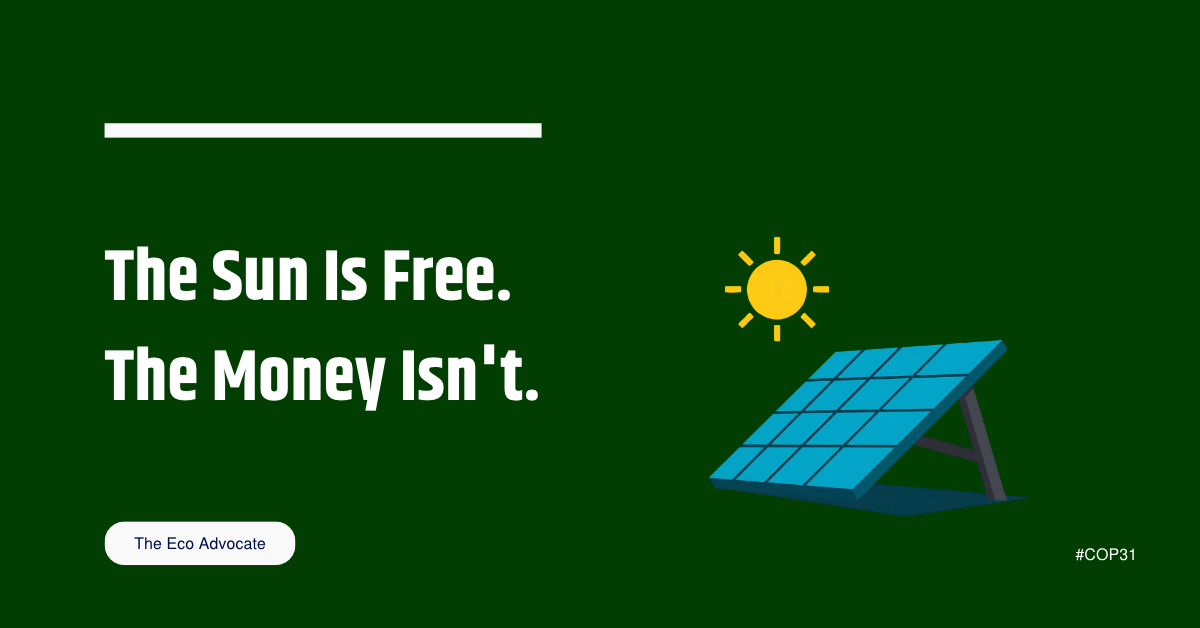
So yes, the sun shines for free. But the money to harness it does not.
What can you do?
- Learn your own energy footprint: what powers your home, your commute and your workplace.
- Support clean cooking and off-grid solar initiatives in your community.
- Ask leaders whether Kenya’s climate plans include clear timelines and funding for the transition.
- Speak up when “transition” means new debt for communities that never caused the crisis.
A transition that leaves Africa in the dark is not a just transition. Let’s keep saying it until it is heard.
Tomorrow: Day 3, when world leaders arrived and the words “polluters must pay” filled the plenary hall.


Discover more from The Eco Advocate
Subscribe to get the latest posts sent to your email.


