
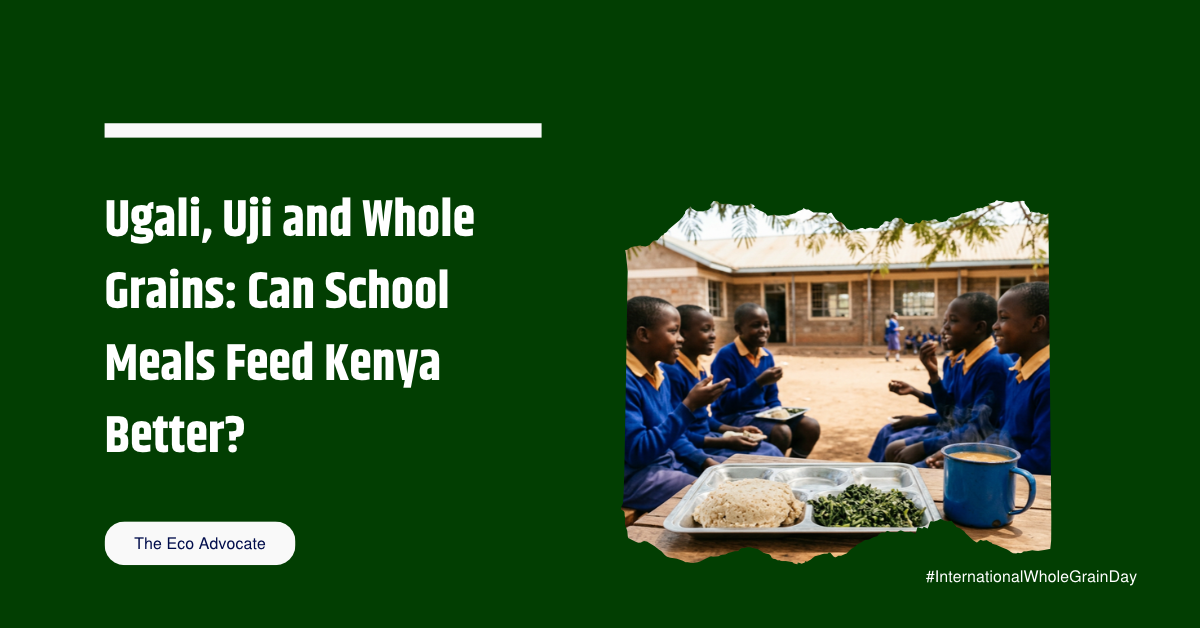
What did you eat for lunch in primary school? If you grew up in Kenya, I can almost guess. A plate of ugali. Some sukuma wiki, if the day was good. And a warm cup of uji to start the morning.
Now here is a question you probably never asked back then: what was actually in that flour?
It matters more than you think. And today, on International Whole Grain Day, it is worth asking again for the millions of children sitting where we once sat.
What are whole grains, anyway?
Every grain of maize, wheat, rice or sorghum has three parts. There is the bran, the outer layer. There is the germ, the small part that would sprout into a new plant. And there is the endosperm, the starchy middle.
When flour is refined, the bran and germ are removed. That gives us the smooth, white flour many of us grew up thinking was the “better” kind. But the bran and germ are exactly where much of the dietary fibre, vitamins and minerals live.
Whole grain flour keeps all three parts. So more of every grain ends up on the plate instead of being stripped away at the mill.
And when whole grain flour is also fortified, with extra vitamins and minerals added during milling, you get what nutrition experts call fortified whole grains.
Why does this matter for Kenyan children?
Because small changes to familiar food can make a big difference.
According to an August 2026 report, Integrating Food and Health Systems in Africa: A High-Return Investment in Health, whole grains carry roughly two to five times the micronutrient density of refined alternatives, depending on the grain and the nutrient. The report was written by Boston Consulting Group, with contributions from The Rockefeller Foundation, Solid’Africa and the Fortified Whole Grain Alliance (FWGA).
Think about that. Same ugali. Same uji. Same plate the children already know and love. Just far more nourishing.
Nobody is asking schools to throw out our food culture. We are talking about making the meals we already eat work harder for our children.
Where do school meals come in?
Across Africa, school feeding programmes reach more than 85 million children. That is a huge, ready-made channel for better nutrition.
The report argues that when schools buy more nutritious food, they also create steady, predictable demand for farmers, millers and processors. So a better school lunch is not just a health win. It can strengthen the whole food system, from the farm to the mill to the classroom.
And here at home, the work has already started. Through partnerships and ongoing programmes, about 600,000 students across several Kenyan counties now eat fortified whole grain maize meal at school, as porridge or as ugali.
Will children actually eat it?
This is the question every parent and cook asks. Fair enough!
So let us look next door to Rwanda.
In a 2021 pilot with 13,500 students, 97% preferred fortified whole-grain maize porridge over the refined version. The programme then grew to more than 74,000 children in 81 schools, and parental approval reached 99%.
Today, the Government of Rwanda is expanding fortified whole-grain maize meal in public schools. Close to 400,000 students already eat it, and the goal is to reach more than 4.3 million learners in phases.
The BCG report also estimated what a wider switch to whole-grain maize, unpolished rice and sorghum could be worth in Rwanda’s school feeding system: about US$120 million to US$155 million a year in combined health, fiscal, economic and environmental benefits.
Those numbers are specific to Rwanda. But the lesson travels well. Children will eat it. Parents will back it. And the whole country gains.
Who needs to act?
All of us. Honestly.
The report is clear that this works only when governments, schools, farmers, millers, food manufacturers and development partners pull in the same direction.
David Kamau, Managing Director of the Fortified Whole Grain Alliance and one of the report’s authors, put the stakes plainly. Millions of children in low- and middle-income countries still face malnutrition and limited access to nutritious food, he said, and FWGA wants fortified whole grains to become “a practical and affordable solution” that helps children thrive.
FWGA’s long-term vision is bold: by 2032, at least half of the grain foods eaten in institutions such as schools, and a quarter of those sold to consumers in low- and middle-income countries, should be fortified whole grains. Down the line, the Alliance also wants to blend in more sorghum, millet and other local, hardy grains.
As someone who writes about the environment, that last part excites me. Hardy local grains cope better with tough seasons. Supporting them means supporting our farmers and building food systems that can stand up to a changing climate.
How can you help?
You don’t need to be a minister or a miller to make a difference. Here is where you can start:
- Ask your child’s school what kind of flour goes into the ugali and uji. Is it whole grain? Is it fortified?
- Bring it up at your parents’ association meeting. Schools respond when parents ask questions together.
- Try whole grain at home. Whole maize meal and whole wheat flour are on most supermarket shelves. Your family’s taste buds will adjust faster than you expect.
- Look for the fortification logo on flour packets when you shop.
- Buy from local farmers who grow sorghum, millet and other traditional grains.
- Talk to your county leaders about how school feeding food is bought, and push for nutrition to come first.
- Share this post. Many people simply don’t know the difference between refined and whole grain flour.
A relay worth joining
This year, International Whole Grain Day, led by the ICC Whole Grain Initiative, is being marked with a global relay started by the Danish Whole Grain Partnership. Organisations from 16 countries, Kenya included, are symbolically passing whole-grain foods from one country to the next.
I love that picture. A plate of food travelling around the world, carrying one simple message: our children deserve better nourishment.
So let’s pick up the baton. Our children cannot walk into the procurement office and ask for better flour. They depend on us to speak up for them.
The next time you see a plate of ugali, ask what’s in it. Then ask for better.
Thank you to the Fortified Whole Grain Alliance and its partners for the work going on in schools across Kenya and the region. Have you seen whole grain meals at your local school? Tell me in the comments.
Source: Fortified Whole Grain Alliance press release, “Kenya eyes greater nutrition gains through whole grains in school meals,” Nairobi, 19 November 2026; and the August 2026 BCG report Integrating Food and Health Systems in Africa: A High-Return Investment in Health


Discover more from The Eco Advocate
Subscribe to get the latest posts sent to your email.


