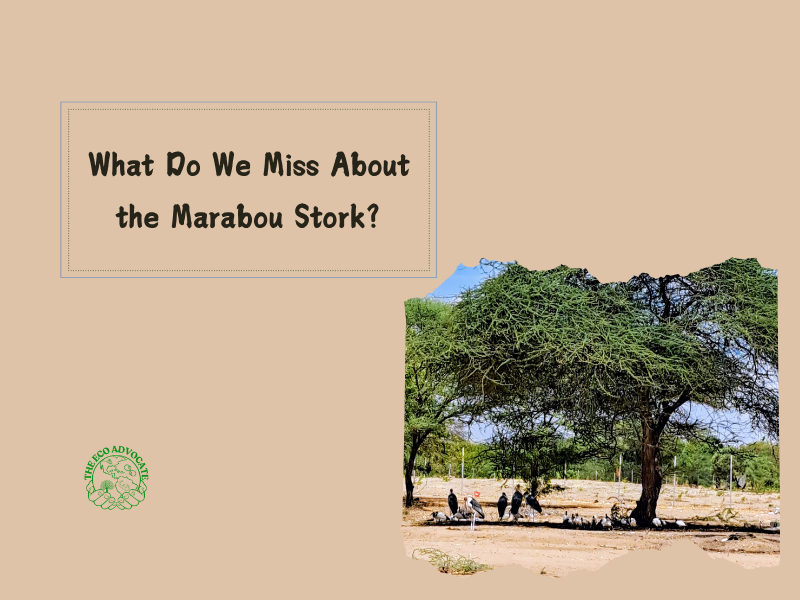
When we think of birds that inspire awe, our minds often drift to elegant cranes, powerful eagles or vibrant toucans. However, the marabou stork rarely comes to mind. This tall, bald bird is often regarded as unattractive or even off-putting, leading many to overlook it entirely. Yet, that would be a mistake, as the marabou stork is not unique but also plays a vital role in our ecosystem. Frequently labelled as “ugly” or “undesirable,” this bird is a key player in waste management, helping to keep our environment clean. So let’s take a moment to look beyond its appearance and recognise the important contributions of the marabou stork to the ecological balance around us.
The Marabou Stork: Nature’s Janitor
To truly appreciate the marabou stork, it’s important to recognise its vital role in the ecosystem. While creatures like lions and elephants often hog the limelight during African safaris, the marabou stork plays an essential, albeit quieter, part in nature’s drama. This impressive bird can stand up to five feet tall and boasts a wingspan that exceeds ten feet. As a scavenger, it feeds primarily on carcasses, decaying matter, and sometimes even urban waste. Although this may seem unappealing to us, scavengers like the marabou stork are crucial for keeping our environments clean and healthy. By consuming animal remains and organic waste, they prevent these materials from contributing to bacteria and disease. In many ways, the marabou stork acts as a frontline worker in nature, managing waste, keeping habitats sanitary and reducing the risk of outbreaks in both wild and urban settings.
Why ‘Ugly’ Should Never Mean Unimportant
In our society, beauty often gets tied to worth, and that perspective can be tricky, especially in conservation. While it’s easy to fall in love with animals like lions and elephants, creatures that inspire us and rally support for important environmental initiatives, countless other species don’t get the same attention simply because they aren’t as cute or appealing. Take the marabou stork, for instance. It’s looks might not win any popularity contests, but it plays a crucial role in its ecosystem. When we focus only on the visually striking species, we risk overlooking the essential organisms that help maintain the balance of nature. It’s vital to remember that every species, regardless of its appearance, contributes to the health of our planet.
Disease Prevention: An Unseen Superpower
The marabou stork is an often overlooked bird with an important role in keeping our environment healthy. By feeding on dead animals and waste, these storks help reduce the amount of decaying organic material in our surroundings, which can attract flies and lead to the spread of diseases. Their presence near human communities, especially in areas with poor waste management, can be both beneficial and problematic. While they play a crucial role in minimising public health risks, many people view them as pests or symbols of dirtiness, not recognising their essential contribution as nature’s clean-up crew.
Consider what our world would be like without scavengers like the marabou stork. In places with warm climates, where decay happens quickly, the absence of these birds could result in a more rapid spread of disease. So, while their appearance might not win any beauty contests, the marabou stork performs a vital ecological service that ultimately helps protect our health.
Urban Adaptation and the Double-Edged Sword of Survival
Marabou storks have demonstrated an impressive ability to adapt to urban settings, particularly in various regions of sub-Saharan Africa. It’s not uncommon to spot them perched on rooftops or foraging through dumps alongside dogs and other scavengers. While this adaptability highlights their resilience, it also brings along significant challenges such as pollution, ingestion of plastic and conflicts over shrinking habitats.
Their growing presence in cities reflects broader societal issues, including poorly managed waste systems, rampant urbanisation and the destruction of natural habitats. It’s important to recognise that these storks don’t choose to thrive in our trash; they are simply making the best of a situation where their natural feeding grounds are becoming increasingly scarce.
Despite the various threats they face, marabou storks continue to adapt, playing a vital role in the ecosystem as scavengers. They help keep our environments cleaner, reminding us of the interconnectedness of our actions and the natural world around us.
A Symbol of Purpose Over Appearance
In a world where appearance often overshadows the essence of things, the marabou stork teaches us an important lesson: purpose is far more valuable than looks. These birds are uniquely designed for their scavenger lifestyle, with features like a bald head, long legs and a large bill that serve critical functions. For instance, their bare heads help prevent bacteria buildup while they feed, while their impressive wings enable them to travel great distances in search of food.
Every aspect of the marabou stork is tailored for efficiency rather than beauty, showcasing the incredible results of evolution rather than human editing. This brings us to reconsider our definition of beauty in nature. Is beauty found in the dazzling colours of feathers, or is it more about the vital roles creatures play in their ecosystems? Does it lie in their appearance or the ways they contribute to the health and balance of their habitats? These are important questions we should be exploring as we deepen our understanding of the natural world.
The Broader Message: Every Species Has Value
The marabou stork is more than just a bird; it serves as a powerful reminder of the intrinsic value of every species, even those that might make us uncomfortable. Its existence challenges us to recognise that worth is not always obvious. Often, the uncomfortable truths we face can lead to the most profound insights.
When discussing topics like sustainability, biodiversity, and environmental advocacy, it’s crucial to broaden our perspective. Conservation efforts shouldn’t solely focus on the adorable or iconic species we often hear about. It’s essential to protect the entire intricate web of life, including the strange and unappealing creatures, like the marabou stork. Every part of this web plays a vital role, reminding us that all species, no matter how odd or overlooked, are important in maintaining the balance of our ecosystems.
Let’s Shift the Lens Together
Imagine a future where children come to appreciate all living creatures, not just the conventionally beautiful ones. Picture documentaries showcasing the majestic lion alongside the often-overlooked marabou stork. In this vision, our conservation efforts are guided by the roles that each species plays in the ecosystem rather than by its appearance.
The marabou stork serves as a reminder to look beyond superficial qualities and recognise deeper truths about our natural world. It teaches us that waste can be valuable if managed properly, and that every organism has a purpose—even those that might be difficult to love. Ecology isn’t a beauty contest; it’s a complex balancing act where each participant matters.
Understanding this principle brings us closer to a kind of environmental stewardship that honours the diversity of life in all its forms, even when they seem messy or unappealing.
In conclusion, while the marabou stork may not win any beauty contests, it plays a crucial role in maintaining ecosystem health, earning its place as an essential contributor to nature’s balance. True sustainability means recognising the importance of all creatures, not just the glamorous ones. Real advocacy begins when we learn to find beauty even in the unconventional. So the next time you encounter a marabou stork, take a moment to look closer. You just might discover one of nature’s most underrated heroes.
FAQs
1. Why is the marabou stork considered “ugly”?
Its bald head, drooping throat pouch, and scavenger habits contribute to its negative image, but these features serve important ecological functions.
2. What role does the marabou stork play in the ecosystem?
It acts as a scavenger, feeding on dead animals and waste, thereby reducing disease and maintaining environmental balance.
3. Are marabou storks endangered?
While not currently endangered, their populations face pressure due to habitat loss, pollution, and conflict with urban expansion.
4. How can we protect species like the marabou stork?
By supporting waste management improvements, preserving natural habitats, and broadening conservation awareness beyond attractive species.
5. Why is it important to conserve “unattractive” species?
Every species contributes to ecosystem health. Losing even the least “cute” creature can disrupt food chains and ecological stability.