
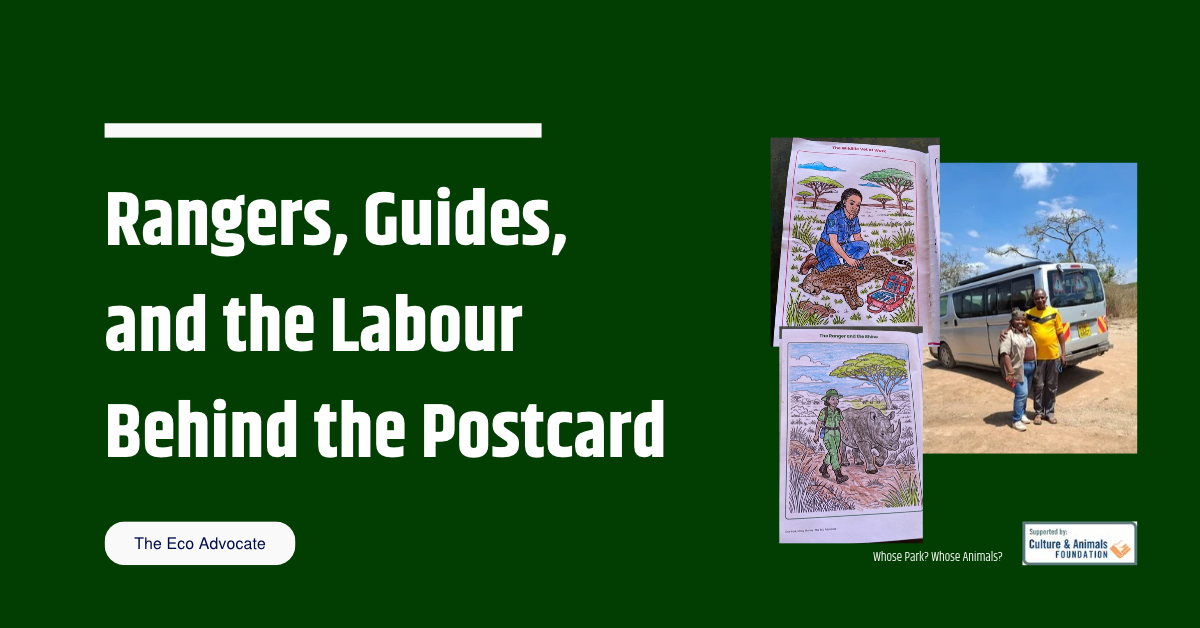
It is 4 am inside the KWS Law Enforcement Academy at Manyani, and a group of recruits is already running. Ninety minutes of it, in the dark, before the day’s real training even starts. By the time the sun is up they will have moved through drills in bush craft, unarmed combat, weapons handling, and ecosystem management, and by midnight they will finally be allowed to sleep, for roughly three hours, before it begins again. One former trainee described the whole experience simply as being “changed from a civilian to a ranger.” Another instructor at the academy put it more plainly still: this, he said, is one of the toughest training grounds in the country.
That is the beginning of the story this essay wants to tell. Not the lion. Not the tourist. The person standing between them, on a wage most tourists paying for the encounter will never think to ask about.
Nairobi National Park, and the wider “urban safari” economy built around it, runs on labour that almost never appears in the photograph. Somebody drove the sedation team to the darted rhino. Somebody scanned the QR code at the gate at six in the morning. Somebody has been walking this park on foot since before dawn, in 25 separate patrol blocks, checking that every one of Nairobi’s rhinos is alive and accounted for. This essay is about them: what they are paid, what they risk, what they are trained to do, and how thin a line separates their working conditions from the polished, high-value tourism product their labour makes possible.
What the job actually looks like
Start with the ranger, because the ranger is the clearest case.
A Kenya Wildlife Service ranger’s basic mandate is security. Patrols, day and night, on foot and by vehicle, inside a park that borders one of Africa’s fastest growing cities on one side and open wilderness on the other. At Nairobi National Park specifically, that means a dedicated Rhino Monitoring and Protection Unit, roughly 79 rangers by KWS’s own count, distributed across 25 monitoring blocks, tasked with locating and physically verifying the condition of every rhino in the park every day, rain or shine. As one KWS profile of the unit put it, a ranger waking up in the morning does not know where the rhinos currently are. They are simply expected to go and find them anyway.
Beyond routine patrol, rangers are also the people who show up when something goes wrong: a lion that has wandered past the fence line into Karen or Rongai, a buffalo that has broken through into community land, a poacher’s snare discovered mid patrol. This is not passive observation. It is active, physical, occasionally armed intervention, carried out by a workforce trained explicitly for it.
That training is not a formality. Since 1990, KWS has run its Law Enforcement Academy at Manyani, inside Tsavo West National Park. New KWS cadets go through nine months of paramilitary training there. Rangers and community conservancy scouts go through a shorter but still demanding three month course covering paramilitary procedure, ecosystem management, human-wildlife conflict response, capture technique, and weapons handling. The academy trained a record 1,274 rangers in a single cohort as recently as December 2024, and continues to draw trainees from as far as Somalia and South Sudan. This is, by any reasonable definition, paramilitary labour. The people doing it are asked to think and act like soldiers protecting a border, because in a very real sense, that is what the park’s edge has become.
What that labour is actually worth on paper
So what does a job like that pay?
Here the picture gets murkier, and it is worth saying so plainly rather than pretending otherwise. KWS does not publish an easily accessible, current salary schedule for public review, and the secondary sources available online disagree with each other by a wide margin. What follows should be read as a range drawn from imperfect sources, not a confirmed figure, and any ranger, union representative, or KWS officer able to correct or sharpen it would be doing this series a real service.
With that caveat: multiple secondary sources converge loosely around a starting range of roughly KES 25,000 to 50,000 a month for a rank and file park ranger, with cadet officers, who enter as university graduates, starting somewhat higher. For scale, Kenya’s own legally mandated minimum wage for a general domestic worker in a major city stood at roughly KES 16,114 a month as of early 2026. A KWS ranger’s starting salary, on the low end of the ranges reported here, sits only modestly above that floor, for a job that requires nine months of paramilitary training and routinely involves darted animals, armed poachers, and wild predators at close range.
That range now has at least one direct confirmation from inside KWS itself. In a questionnaire answered as part of this series’ fieldwork, *Peter * (not their real name), who works in a support role at Nairobi National Park and has been with the agency for one to five years, reported a monthly pay bracket of KES 25,000 to 50,000, exactly the low end of the range this essay had pieced together from secondary sources alone. Asked what would most improve his working conditions, his answer was specific rather than abstract: monthly stipends, on top of base pay. Asked whether he had personally experienced significant risk or threat in the course of his work, he said no, a reminder that not every KWS role carries the same exposure a Rhino Monitoring and Protection Unit ranger does, even inside the same institution and the same pay bracket. Asked where Nairobi National Park’s revenue actually goes, he pointed to habitat management, wildlife translocation, community programmes, and administrative costs, the same categories KWS cites publicly, and said he was not aware of any internal discussion of reduced or subsidised access for Nairobi residents, the exact gap Essay 1 raises.
The risk side of that equation is easier to document, because it tends to make the news in a way payslips do not. KWS’s own 2013 annual report recorded three rangers killed in the line of duty that year alone. Kenya has continued to lose officers since: KWS Assistant Warden Bajila Obed Kofa was shot dead in his car in 2021 after dropping his daughter at school, one of two senior KWS officers killed that year in what conservation groups described as targeted attacks tied to rhino poaching syndicates. Continent wide, the Game Rangers’ Association of Africa recorded at least 384 ranger deaths across the continent between 2012 and 2020. This is not only a story of external threat, either, in January 2026, a KWS ranger in Kwale shot and killed a police officer and then himself, in a dispute that began over two goats, a reminder that a workforce carrying military grade weapons under sustained stress needs institutional support this series found little visible evidence of.
What the tourism side of the same encounter pays and charges
Now put the ranger’s pay slip next to the price of the experience their labour makes possible.
A private half-day Nairobi National Park safari, the kind sold to international visitors as a quick, convenient wildlife fix squeezed between flights or meetings, typically runs from around 200 US dollars total for a single guest down to roughly 50 to 65 dollars per person once a group of six to eight is sharing the vehicle, before park entry fees are even added. An Airbnb Experience listing for a Nairobi National Park safari tour, hosted independently rather than through a large agency, was priced starting from 100 US dollars per guest at the time of research.
Where does that money actually land? A meaningful share goes to vehicle costs, fuel, and the operator’s margin, but a real portion is meant to compensate the guide directly, and here the numbers, again drawn from imperfect secondary sourcing, suggest a workforce doing considerably better than a KWS ranger, though still leaning heavily on tips to close the gap. One long running Kenya tourism forum thread put a salaried top tier driver guide’s monthly base pay at around KES 35,000, with tips from clients, often suggested at 10 to 30 US dollars per client per day on a private safari, making up what can be a very large share of actual annual earnings. Freelance and informally employed guides working outside any agency structure, along with the informal photographers who work Nairobi’s gate areas offering instant printed souvenir photos to visitors, sit further down that ladder still, entirely dependent on daily footfall and tips, with no salary floor beneath them at all.
Gate and ticketing staff sit in a similarly under documented position. Since KWS moved its ticketing fully onto the eCitizen digital platform, much of the transactional work that used to require a person physically handling cash at a gate booth has shifted toward the KWSPay portal itself. What remains, human staff scanning QR codes, verifying identification documents, managing the flow of vehicles, is real, ongoing labour, but it is largely invisible in every account of what makes the “urban safari” work, including, it must be said, this series so far. This essay found no reliable published figure for what a KWS gate or ticketing clerk specifically earns, which is itself a small data point about whose labour tends to get counted and whose does not.
The missing character in every wildlife tourism story
Step back, and a pattern becomes visible that runs through nearly every popular account of a place like Nairobi National Park, including glossy magazine features, KWS’s own promotional material, and, if this series is honest with itself, the first two essays in it.
The animal is the subject. The tourist is the audience. Almost every narrative structure available for talking about wildlife tourism puts those two figures at the centre and leaves everyone else as scenery: a uniformed extra standing at the edge of the frame, present but unnamed, there to make the encounter feel safe and authentic rather than to be understood as a person with a wage, a training history, and a level of occupational risk worth asking about.
That omission is not neutral. It has a direct effect on how the labour gets valued, because a workforce nobody is asked to think about is a workforce nobody is pressured to pay better. The ranger doing the physically dangerous, professionally demanding work of finding and protecting a rhino population earns, by the most consistent estimates available, somewhere in the range of a junior clerk’s salary. The guide translating that protected animal into a marketable half day experience for a paying foreign visitor can, at the upper end of the trade, earn several times that. Both of them are doing something real and skilled. Only one of them is standing directly between a poacher and an endangered species for a wage that barely clears the country’s own minimum threshold for domestic labour.
None of this is to suggest that guides are overpaid, many of them are themselves scraping by on inconsistent, tip dependent income with no safety net between bookings. It is to say that the entire chain, ranger, capture team vet, guide, gate clerk, informal photographer, is unevenly compensated relative to both its risk and its role in producing the experience visitors are paying for, and that unevenness is very hard to see if you never ask the question in the first place.
What fair labour would actually require
This series has spent two essays asking who a park is for and what conservation costs an animal. This one closes by asking what it would take to make the labour underneath both of those questions fair, not as a vague aspiration, but as something concrete enough to actually push for.
- Publish the pay scale. KWS operates as a state corporation whose fee revenue is public knowledge in granular detail. Its ranger salary structure should be equally public, verifiable, and easy for a journalist, researcher, or ranger’s family member to find without relying on scattered, contradictory secondary sources the way this essay had to.
- Fund hazard pay that matches documented risk. A workforce trained for nine months in paramilitary procedure, armed, and statistically exposed to homicide risk on the job deserves compensation structured around that reality, not around a generic civil service grade.
- Build real mental health support into the ranger pipeline. Recent, disturbing cases inside KWS itself point to a workforce absorbing sustained psychological strain with little visible institutional response. That gap is a labour issue as much as a security one.
- Ask tour operators to disclose what guides actually take home. A visitor paying 100 or 200 US dollars for a half day safari has no easy way to know what share of that reaches the guide beside them versus the agency or the platform.
- Stop leaving gate staff, drivers, and informal photographers out of the story. Any account of “who manages this encounter” that stops at rangers and guides is still an incomplete one.
The rhino in the photograph was found, tracked, and kept alive by someone earning a fraction of what the photograph itself is worth to sell. The lion collared to keep it safe from a Nairobi suburb was darted by a team whose own safety net is thinner than most of the tourists paying to see the result. An ethical wildlife tourism frame, the kind this series keeps reaching for, cannot only ask what we owe the animals. It has to ask, with the same seriousness, what we owe the people standing quietly at the edge of every good photograph, doing the work that makes the postcard possible.
Sources
1. CGTN Africa, “Faces of Africa: Train hard, Fight Easy” (Manyani training regime, first-hand account): https://africa.cgtn.com/2018/08/06/faces-of-africa-train-hard-fight-easy/
2. WildLandscapes International, “The largest ever KWS Law Enforcement Academy Graduation” (Dec 2024, 1,274 rangers): https://wildlandscapes.org/news/the-largest-ever-kws-law-enforcement-academy-graduation
3. The Star, “KWS launches housing project for rhino protection at Nairobi National Park” (Mar 2021, 79-strong rhino unit, 25 monitoring blocks): https://the-star.co.ke/news/2021-03-08-kws-launches-housing-project-for-rhino-protection-at-nairobi-national-park
4. Africa Defense Forum, “Rise in Park Ranger Deaths Shows High Stakes of Wildlife Protection” (continental ranger death statistics, Bajila Obed Kofa killing): https://adf-magazine.com/2022/09/rise-in-park-ranger-deaths-shows-high-stakes-of-wildlife-protection/
5. Trading Economics, “Kenya Minimum Wages” (2026 minimum wage figure): https://www.tradingeconomics.com/kenya/minimum-wages
6. Questionnaires and Interviews


Discover more from The Eco Advocate
Subscribe to get the latest posts sent to your email.


