
Picture this. It is just after dawn inside Nairobi National Park. A helicopter is circling low over Rhino Valley, and on the ground below, a team of Kenya Wildlife Service veterinarians and rangers is waiting, dart guns ready, for a signal. Somewhere in the grass ahead of them is a black rhino, one of three being prepared that morning for a journey north to Loisaba Conservancy, a wild place her species has not called home in fifty years.
The dart finds its mark. The drug takes hold. And then something goes wrong that nobody planned for: the rhino, disoriented and stumbling under sedation, staggers into a river inside the park.
It takes more than five KWS vets to pull her out.
That single image, a sedated rhino half submerged in water while a team of professionals fights to save her, is as honest a place as any to start this essay. Because everything that makes Nairobi National Park work as a conservation success story also makes it a place where wild animals are handled, moved, drugged, and redirected with a frequency and intimacy that would be unthinkable in a place like the Serengeti or Tsavo. This is not incidental to the park’s identity. It is the park’s identity. Nairobi National Park does not just contain wildlife. It manages it, continuously, by hand.
So this essay asks a harder question than “is this cruel” or “is this necessary.” It asks: what does it actually cost an animal to be made visible, countable, and safe, in a landscape built for exactly that purpose?
A Park Too Small To Leave Anything To Chance
To understand why Nairobi National Park’s animals get this much hands-on attention, you have to understand what a strange piece of geography this park actually is.
It covers just 117 square kilometres, a little more than a tenth the size of the Maasai Mara. It is fenced on three sides. The fourth side, the southern boundary, opens onto the Kitengela plains, a wildlife dispersal corridor that has been steadily swallowed by fences, farms, and new housing developments as Nairobi’s population has grown. In other words, this is a park with almost nowhere for its animals to go when things get crowded, and less room every year for the corridor that used to relieve that pressure.
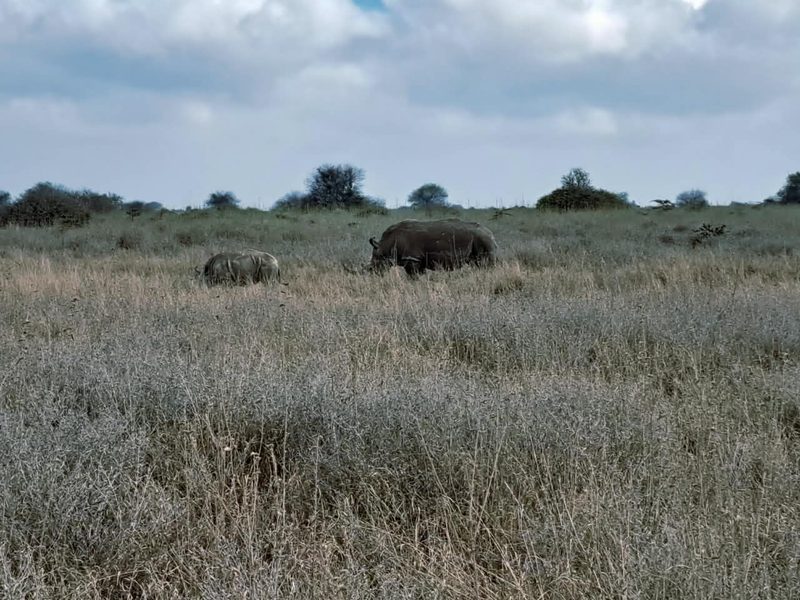
Rhinos illustrate the problem most clearly. Nairobi National Park had zero rhinos until 1996, when KWS declared it a sanctuary and began introducing animals as part of a nationwide strategy to rebuild a population that had collapsed from roughly 20,000 individuals nationally in the 1970s to under 400 by the mid 1980s, almost entirely due to poaching. The introduction worked, perhaps too well. By mid 2025, KWS Director General Erustus Kanga put the population at around 175 rhinos, well above what he says the park can ecologically support. Black rhinos are solitary and fiercely territorial. Crowd them, and males fight, sometimes fatally. Crowd them further, and their birth rates fall, because the animals themselves respond physiologically to overcrowding by suppressing reproduction. “We are suffering because of our success,” Kanga has said.
This is not just a field director’s impression. Kenya’s Black Rhino Recovery and Action Plan 2022-2026, the national strategy document governing how KWS manages the species, formally lists Nairobi National Park among six black rhino areas nationally that sit above their ecological carrying capacity, the technical designation that triggers exactly the kind of translocation programme described below. The plan treats this as a success condition requiring active management, not a crisis: Kenya’s black rhino population has grown for three decades straight, and overcrowding at the top end of that growth curve is the kind of problem a species that nearly went extinct is fortunate to have. But it still has to be managed, animal by animal, at real risk, as the next translocation shows.
Lions face a related but different version of the same trap. The park’s lion population roams a territory a fraction of the size a wild lion pride would naturally claim, lions can range across more than 400 square kilometres in an unfenced system; Nairobi National Park gives them 117, shared with rhinos, buffalo, and a fenceline pressed hard against one of Africa’s fastest-growing cities. Lions leave, drawn out by prey shortages or old migratory instincts that predate the city around them. When they leave, they meet livestock, and sometimes people, and the encounter rarely ends well for anyone involved, least of all the lion.
This is the honest starting point for everything that follows. Nairobi National Park’s wildlife management is not an optional layer of intervention added on top of a naturally functioning ecosystem. It is what keeps a naturally undersized, overcrowded, edge-dominated system from tearing itself apart.
What It Actually Takes To Move A Wild Animal
So what does “management” mean in practice? It means darting, immobilising, crating, trucking, and releasing an animal that has no way of understanding why any of this is happening to it.
The 2024 translocation of 21 black rhinos from Nairobi National Park and two conservancies to Loisaba, described by KWS as its most significant rhino relocation to date, gives a clear picture of what the procedure actually involves. A helicopter locates and herds the target animal. A veterinarian darts it from the air or the ground with an immobilising drug. Once sedated, the rhino is blindfolded and earplugged to reduce stress, then physically manoeuvred into a purpose-built steel crate for the journey, sometimes days long, to its release site. The Loisaba operation took eighteen days from first capture to final release, executed under the IUCN’s international translocation guidelines and Kenya’s own 2019 immobilisation protocol, a protocol that exists precisely because this process has gone wrong before, and badly.
In June 2018, KWS moved eleven black rhinos, several of them from Nairobi National Park, to a newly fenced sanctuary at Tsavo East, in what was meant to be a routine, well resourced translocation. Within weeks, the operation had become, in the words of conservationist Paula Kahumbu, “a complete disaster.” Ten of the eleven rhinos died from what an official inquiry called multiple stress syndrome, intensified by salt poisoning after the animals drank from a borehole whose water was far saltier than anything they were used to. The eleventh, weakened by the same ordeal, was attacked by lions that had never encountered a rhino in their lives and died soon after. Kenya’s wildlife ministry called the death toll “unprecedented,” noting that of 149 rhinos translocated nationally between 2005 and 2017, only eight had died in the process. In one operation, the country lost more black rhinos than poachers had killed in the two previous years combined.
That contrast, roughly five percent mortality across well over a decade of translocations, followed by a single catastrophic operation with over ninety percent mortality, is the clearest illustration available of the documented risk this essay’s brief asks about. The underlying physiological danger even has a name: capture myopathy, in which the extreme stress of capture triggers a cascade of muscle breakdown, kidney failure, and death that can unfold anywhere from minutes to weeks after the animal was darted. With careful protocol, published research suggests the incidence of fatal capture myopathy can be pushed below two percent. Without that care, Tsavo shows exactly how catastrophic the alternative looks.
None of this is offered to suggest that translocation is reckless or that KWS’s vets are careless. The opposite argument is at least as strong: without translocation and sedation as tools, Nairobi National Park’s rhino population would still be at zero, not 175. But the mortality numbers are real, and an essay that only tells the triumphant version of this story is not being honest about what saving them has occasionally cost.
Collars, Not Cages, But Still Not A Choice
Lion management looks gentler on paper, mostly because it rarely ends in death. But it raises its own, quieter version of the same ethical question.
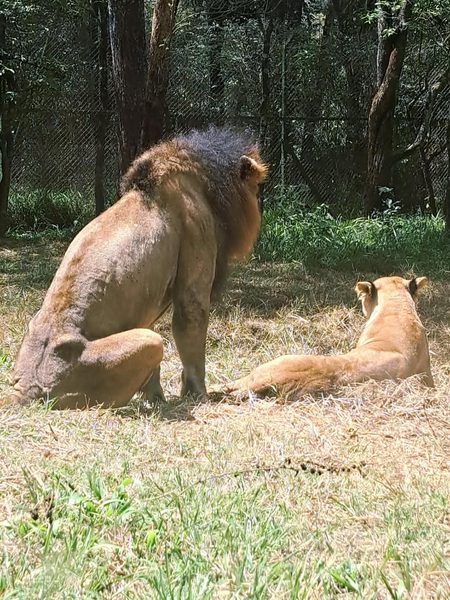
Since 2017, KWS has fitted a rolling number of Nairobi National Park’s lions with satellite GPS collars, work initially supported by the International Fund for Animal Welfare. The logic is straightforward and, on its own terms, humane. A collared lion’s location updates in near real time. When that location starts drifting toward the park’s edge, rangers can move to intercept before the lion reaches a boma full of livestock, rather than after, a real difference, given that two male lions had been shot dead by rangers in two days the previous year, before any early warning system existed.
A 2018 peer-reviewed study in PLOS ONE, led by researcher Francis Lesilau with KWS and Leiden University, examined a decade of livestock predation records around the park’s southern boundary and found that flashing LED lights installed on livestock enclosures, an idea that originated with an eleven-year-old Maasai boy named Richard Turere, defending his family’s herd, reduced nighttime lion attacks by a wide margin. But the study found something less comfortable underneath its positive headline: once flashlights made a boma harder to raid at night, attacks did not stop. They shifted, both to daylight hours and toward bomas that had not yet installed lights. Every intervention here, from flashlights to collars, is solving one version of the conflict while quietly displacing another version of it somewhere else along the fence line.
Collaring itself is not risk-free either, even if the risk is smaller and less visible than a botched rhino translocation. It still requires darting a fully grown lion, and it still means a wild predator spends the rest of its life carrying hardware it never asked to wear, feeding a data stream to an authority it has no way of understanding, let alone consenting to.
Whose Consent Does Conservation Actually Assume
This is the crux the whole essay has been circling. Every rhino translocation, every lion collar, every dart fired from a helicopter rests on a decision made entirely on the animal’s behalf, by people who are certain they know what is good for it.
In one sense, that is simply what conservation is, and always has been. Wild animals cannot consent to being managed any more than a coral reef can consent to being reseeded. If the alternative to intervention is a shrinking, inbred, locally extinct population, then the absence of consent starts to look less like an ethical violation and more like an unavoidable feature of trying to save something at all. Take away the chain of unconsented interventions and there is very likely no rhino population in this park to protect at all.
But naming that trade off honestly still matters, because it is a trade off, not a neutral fact of nature. A collared lion is being tracked for reasons that serve human safety and human livestock every bit as much as they serve the lion’s own survival. A translocated rhino is being moved because a population that KWS itself helped engineer into existence has now outgrown the fence line that same agency built around it. The rhino did not create the overcrowding problem. Humans did. The animal bears the physical risk, the sedation, the crate, the journey, for a crisis that was never of its own making.
Held side by side, both of those things are true at once. This management keeps the population alive. And it is still, every single time, an imposition on an animal that never asked to be part of anyone’s conservation strategy.
Whose Sighting Is This, Really
There’s one more layer worth being honest about: how much of this intensive, expensive, physically risky management is really about the animal’s survival, and how much of it is about keeping the sightings reliable for the people paying to see them.
The two goals overlap so thoroughly at Nairobi National Park that they are almost impossible to fully separate, and that overlap is itself worth sitting with rather than resolving too quickly. A healthy, growing, well monitored rhino population is good for the rhino. It is also, unmistakably, the park’s single strongest tourism asset, the reason KWS markets Nairobi National Park internationally as one of Africa’s most reliable rhino sighting destinations, the reason a half day urban safari can promise visitors an encounter that would take days of searching in a larger, wilder park. Lions collared and steered away from conflict zones are lions less likely to be shot by a ranger protecting a homestead. They are also lions more likely to still be alive, findable, and photogenic for the next morning’s game drive.
None of that makes the conservation effort insincere. Rangers who spend eighteen days in the field moving eleven rhinos are not doing it for a tourism brochure. But the funding models behind that work sit inside a system where a park that stops delivering reliable, marketable sightings is a park that struggles to fund the very protection its animals depend on. The management exists for the animal. The animal’s visibility funds the management. It is a closed loop, and pretending it is not would be its own kind of dishonesty.
So where does that leave us? Maybe here: the next time you see a photograph of a rhino grazing against Nairobi’s skyline, or a lion collar catching the light in a safari video, it is worth remembering what is actually underneath that image. A helicopter. A dart gun. A team of vets who have, more than once, pulled a sedated animal out of a river with their bare hands because the alternative was letting it drown. A protocol rewritten in blood after eleven rhinos were killed by our best intentions in 2018. None of that cancels out the real, measurable success this park represents. It just means the success was never free, and the ones who paid for it most directly were never asked.
What This Means For How We Watch
This isn’t a call to stop visiting the park, or to treat every collar and translocation as an act of cruelty. It’s a call to watch with fuller eyes.
- Ask what “protected” actually costs, not just what it delivers. A thriving rhino population and a translocation with a real mortality risk are not contradictory facts. They are the same fact, told honestly.
- Look past the sighting to the system that produced it. A collared lion or a notched rhino ear is not a flaw in the photograph. It is the photograph’s true subject, if you know how to read it.
- Support the protocols, not just the outcomes. Holding KWS to the standards written after Tsavo, and asking questions when translocations happen quickly or quietly, is part of what keeps the next operation from becoming the next disaster.
- Talk about the 2018 disaster, not just the recovery story. Conservation narratives tend to keep the triumphant chapters and quietly drop the disastrous ones. A fuller, more honest story serves the animals better than a flattering one.
- Notice the loop between funding and visibility, and ask what happens to the animals who are hardest to see, and therefore hardest to fund.
Nairobi National Park’s rhinos and lions are among the most intensively managed wild animals on the continent. That is not an accusation. It is simply what it takes to keep a population like this alive inside a fence this small, beside a city this big. But intensively managed is not the same as freely living, and this series has never been interested in pretending those two things are the same thing wearing different names. The animals in this park are never just watched. They are tracked, sedated, and moved, over and over, by people who love them and are trying, imperfectly, to keep them here at all.
Sources
1. Mongabay, “Black rhinos moved to Kenya’s Loisaba Conservancy as species recovers” (Feb 2024): https://news.mongabay.com/2024/02/black-rhinos-moved-to-kenyas-loisaba-conservancy-as-species-recovers/
2. Save the Rhino International, “11 rhinos have died after relocation to Tsavo East” (Aug 2018): https://www.savetherhino.org/africa/kenya/all-rhinos-translocated-to-tsavo-east-national-park-have-died/
3. Breed, D., Meyer, L.C.R., Steyl, J.C.A., Goddard, A., Burroughs, R. and Kohn, T.A., “Conserving wildlife in a changing world: Understanding capture myopathy, a malignant outcome of stress during capture and translocation,” Conservation Physiology, Vol. 7, No. 1 (2019): https://academic.oup.com/conphys/article/7/1/coz027/5528374
4. Lesilau, F. et al., “Effectiveness of a LED flashlight technique in reducing livestock depredation by lions (Panthera leo) around Nairobi National Park, Kenya,” PLOS ONE, Vol. 13, No. 1 (2018): https://journals.plos.org/plosone/article?id=10.1371%2Fjournal.pone.0190898
5. The Star, “KWS mulls relocation as rhino population overruns Nairobi National Park” (Jul 2025): https://www.the-star.co.ke/counties/nairobi/2025-07-10-kws-mulls-relocation-as-rhino-numbers-overrun-nairobi-park
6. Kenya Wildlife Service, Black Rhino Recovery and Action Plan 2022-2026 (ecological-carrying-capacity designation for Nairobi National Park), via the Ministry of Tourism and Wildlife downloads page: https://www.tourism.go.ke/downloads/
7. Questionnaires and Interviews


Discover more from The Eco Advocate
Subscribe to get the latest posts sent to your email.


