

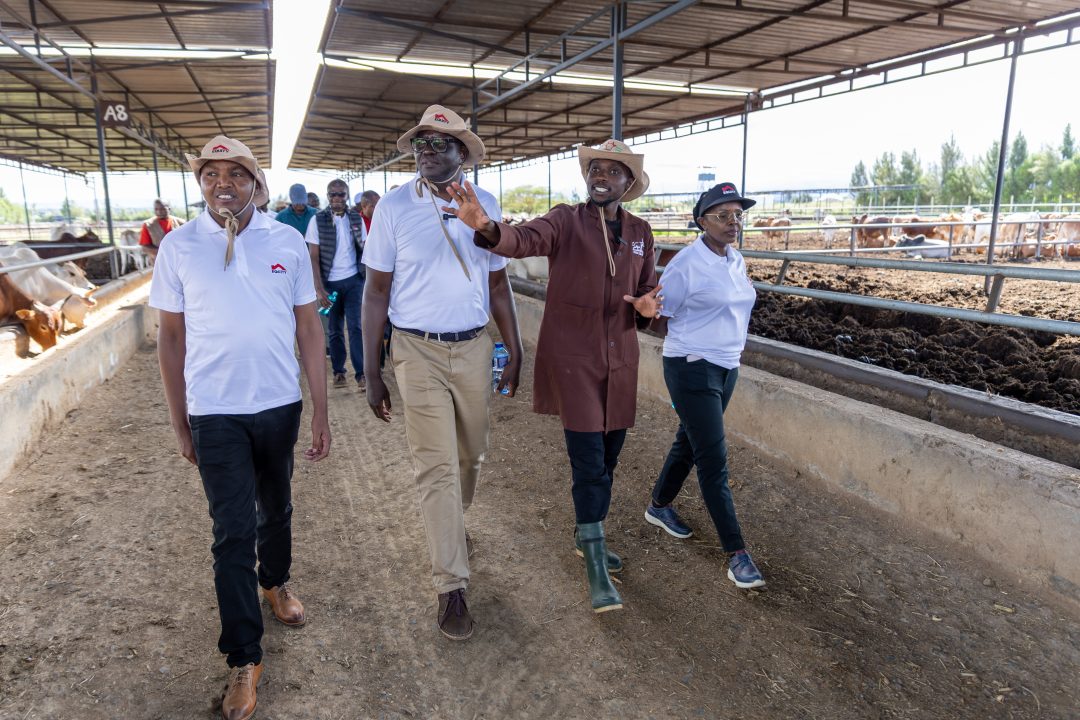
There is a quiet revolution happening in the plains of Rumuruti, Laikipia County, and it is not the kind that announces itself with fanfare. It does not arrive in the form of a foreign NGO, a government pilot programme, or a glossy international report. It arrives in the form of a farmer who decided that selling beef the old way was leaving too much value and too much dignity on the table.
Philip Kimeru, chairman of Ongole Beef Farm, is running a cattle operation with more than 2,000 head of livestock. But what struck me about his story is not the scale. It is the philosophy.
“We are focused on achieving optimum revenue multiplication per steer,” he says.
That sentence deserves more attention than it will probably get.
When the Market Gap Becomes a Wake-Up Call
Here is the brutal arithmetic that every Kenyan beef farmer knows but rarely says out loud: a kilo of steak sold locally fetches around KSh 800. In a premium market, that same kilo can go for KSh 6,000.
That is not a small difference. That is a canyon.
And for too long, the farmers who raise the animals have been earning at the bottom of that canyon while middlemen and high-end retailers sat comfortably at the top. This is despite living in harsh, semi-arid landscapes, absorbing all the ecological and financial risk,
Kimeru’s response has not been to complain about the gap. It has been to build a bridge across it.
The “Whole Cow, Whole Harvest” Model
I love this phrase. It is so Kenyan in its pragmatism. It reminds me of how our grandmothers cooked. Nothing was wasted.
At Ongole Beef Farm, the philosophy means extracting value from every part of the animal: meat cuts, bones, hides. It means controlling the chain from breeding to slaughter to retail, with a halal-compliant, near-fully automated slaughterhouse, cold storage, and a premium outlet in Karen, Nairobi.
This is vertical integration being applied thoughtfully on Kenyan soil, by a Kenyan farmer, for Kenyan markets. That matters.
Organics and Closed Loops: The Ecological Thread
This is the part that really caught my attention as an environmental advocate.
The farm grows its own maize, cotton, and hay using organic methods. Animal manure is recycled back into crop production. Feed costs, which are the biggest expense, are being brought in-house.
This is a closed-loop system. It is the kind of circular economy that we talk about endlessly in environmental circles but rarely see functioning at this scale in Kenyan agriculture. The farm is not just asking how do we make more money? It is asking how we can reduce dependence on external, often chemical, inputs while building soil health.
These questions belong together. Profitability and ecological integrity are not opposites, and this farm is living proof.
The Pastoralist Connection: Who Else Is at the Table?
One detail in this story that I do not want us to scroll past: the farm sources part of its livestock from surrounding pastoralist communities, integrating these animals into its system after quarantine and professional assessment.
This is potentially one of the most important parts of the model.
Pastoralist communities in Laikipia and the wider northern rangelands have long been caught in cycles of low prices, exploitative brokers, and exclusion from premium value chains. If Ongole Beef is genuinely creating a pathway for small-scale pastoralists to access higher-value markets with fair terms, then that is transformative.
I say if deliberately. The feature does not give us enough detail to assess the terms of these linkages. Are pastoralists paid fairly? Do they have any say in how the system works? These are questions worth asking and worth reporting on further.
Because a value chain that lifts the farmer at the centre while continuing to extract from the community at the edges is not a revolution. It is just a more efficient version of the old model.
Technology as a Tool, Not a Trophy
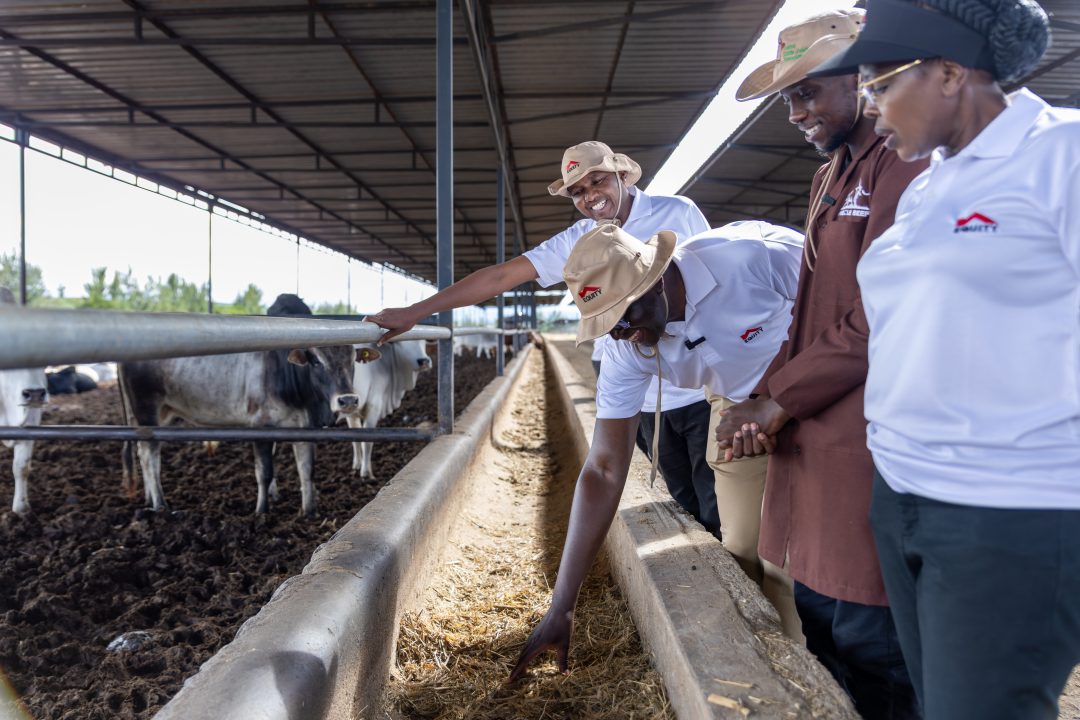
Every animal at Ongole Beef is electronically tagged and tracked through its lifecycle. This is not innovation for its own sake, traceability is a hard requirement for export and premium market access. It is practical, appropriate technology.
I appreciate that. In so many conversations about “agritech in Africa,” we are sold expensive, imported solutions that do not survive the first rainy season. What works here is technology embedded in a larger system of good practice. That is organic feeds, animal welfare, skilled staff as well as market relationships.
The technology serves the model. The model is not serving the technology. That is the right order.
A Word on Finance and Who Gets to Scale
Equity Bank Kenya has expressed interest in the farm, with MD Moses Nyabanda visiting the facility and signalling the bank’s ambition to grow agricultural lending to 30% of its balance sheet.
Good. Kenya needs serious agricultural finance. But I want to hold this alongside a question that development finance too rarely asks: who else needs this kind of investment, and what barriers are stopping them from accessing it?
A large, integrated, premium beef operation with cold chain and retail infrastructure is an attractive proposition for a bank. A smallholder pastoralist woman in Isiolo or a subsistence cattle keeper in Kajiado is not, at least not on terms that banks currently offer.
If the Ongole model can become a template, the critical challenge will be: how do we bring the rest of the value chain into the same financial ecosystem, including the most vulnerable producers?
What This Means for the Broader Conversation
Kenya loses enormous value every year because our agricultural systems are fragmented, undercapitalised, and oriented toward raw commodity export rather than local value addition. Beef is no exception.
What Philip Kimeru is building in Rumuruti is a rebuke to that pattern. It is an argument, made in cattle and cold storage and organic mulch, that Kenyan farmers do not have to accept the bottom of the value chain as their permanent address.
It is also, quietly, an environmental argument. Organic methods, manure recycling, reduced external inputs, and closed loops are not just good for the bottom line. They are good for the land. They are what sustainable livestock production at any scale needs to look like.
I will be watching this story. I hope others will be too.
Have thoughts on the future of sustainable beef farming in Kenya? Drop them in the comments or reach out at chechewinnie.com. And if you know of pastoralist communities whose relationship with farms like this one deserves a closer look. I would love to hear from you.


Discover more from The Eco Advocate
Subscribe to get the latest posts sent to your email.


