
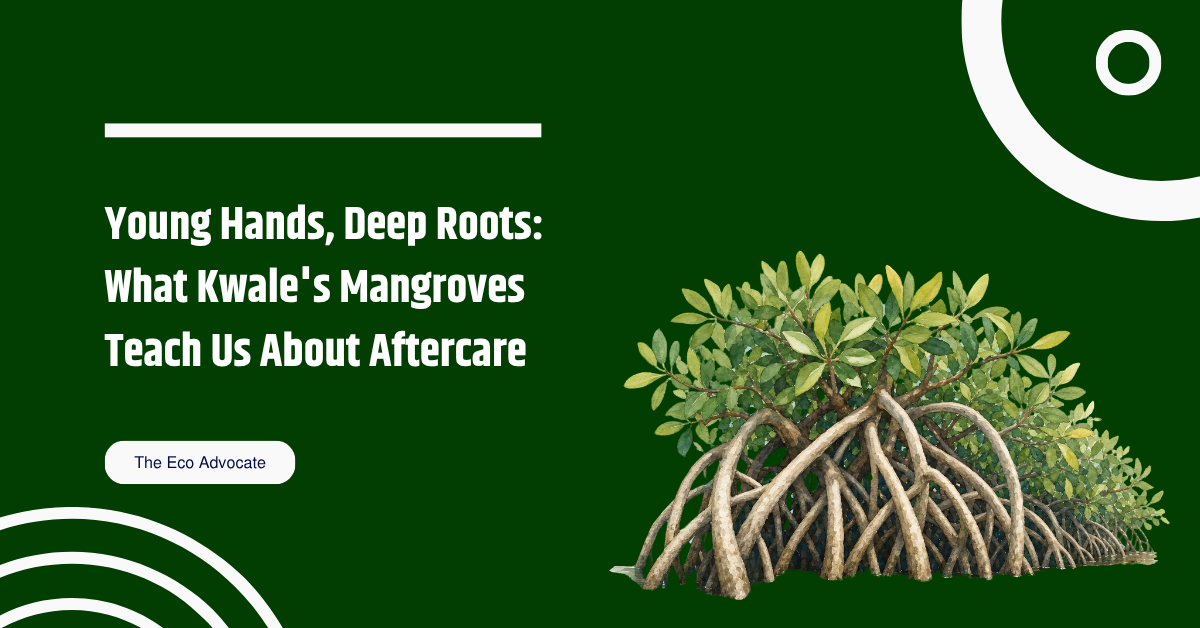
Have you ever stood knee-deep in coastal mud, pushing a mangrove propagule into the soil while the tide creeps back in? I have. And I can tell you, it’s one of the most humbling kinds of conservation work there is.
I took part in mangrove planting with a youth- and women-led organisation, the Blue Earth Organisation, and one thing stood out above everything else. They didn’t just plant and leave. They kept coming back to care for the young trees, and they worked hand in hand with the community long after planting day.
So when I read the Global Environment Facility’s story on youth-led mangrove restoration in Kwale, I found myself nodding the whole way through.
What’s happening at Nyumba Sita?
At Nyumba Sita, on Kenya’s South Coast in Kwale County, a forest is growing where there was barely one a decade ago. The work is led by the Kenyan Youth Biodiversity Network (KYBN), founded in 2017 and now made up of more than 1,200 members and 45 grassroots groups.
Working alongside the Shangani Amani Self-Help Group, a group of mostly fisherfolk who also farm seaweed, KYBN has restored more than 15 hectares of degraded mangroves. More than half of the young people involved come from nearby schools and colleges, including the Ukunda Vocational Training Institute, Pwani University and the Technical University of Mombasa.
They raise seedlings in nurseries, learn which mangrove species suit which spots, and plant them along the shore. Now the network is aiming for 200 hectares by 2030.
Why do young people make such good restorers?
From what I’ve seen, three reasons.
- They stay. Mangrove seedlings need tending: replanting the ones the tide pulls out, clearing plastic, protecting them from cutting. Youth groups living nearby can keep showing up.
- They build bridges. At Nyumba Sita, youth work hand in hand with fishers, county officials and local leaders. The local chief even described the work as young people helping older generations repair the damage done when mangroves were cut down years ago. That’s not a generation gap. That’s a partnership.
- They think about livelihoods. KYBN plans mangrove honey and ecotourism, so restoration also puts money in local pockets. When a forest pays, people protect it.
Why mangroves matter so much
Mangroves are some of the hardest-working ecosystems we have. They hold the shoreline together, break the force of storms, act as nurseries for the fish coastal families depend on, and store huge amounts of carbon. As the Shangani Amani fishers say, no mangroves means fewer fish. It’s that simple.
I’ve written before about how much wetlands and swamps do for us, and why seedlings planted is not a survival rate. Mangroves prove both points. A planting day makes a nice photo. Aftercare makes a forest.
How can you support this?
- Join or back a youth-led coastal group. Your time or a small donation goes far.
- Ask about aftercare. Before funding any planting, ask who will look after the seedlings for the next three years.
- Keep plastic off the beach. Trash smothers young mangroves.
- Buy from mangrove-friendly enterprises, like local honey or community-run eco-tours.
Over to you
To every young person who has ever gone back to check on a seedling nobody was watching: thank you. That’s where real restoration happens.
Have you planted mangroves or another tree with a youth group? Did the group go back to care for them? Tell me in the comments.
Source: Global Environment Facility, 7 October 2026


Discover more from The Eco Advocate
Subscribe to get the latest posts sent to your email.


