
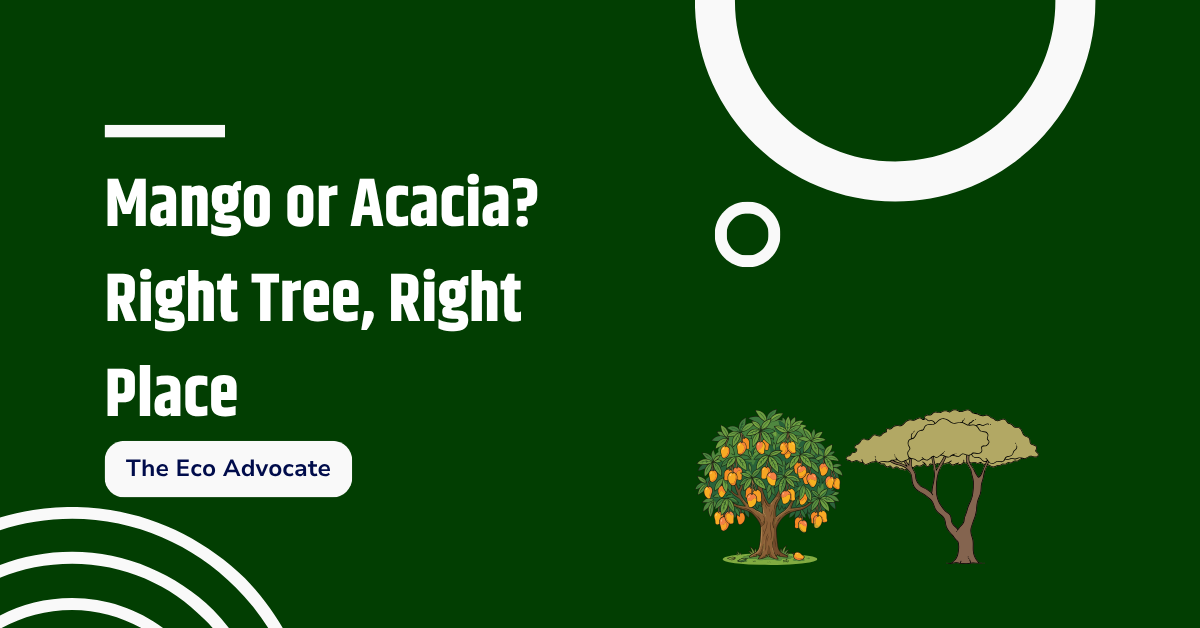
Should you plant a mango tree or an acacia? A fruit tree or an indigenous one?
I get asked some version of this every planting season. And the honest answer is: it depends where you’re standing. Kenya needs both, planted in the right places.
So with Mazingira Day falling this Saturday, let’s settle it.
What do fruit trees give us?
A reason for children to water them.
Food, shade and eventually income are immediate, visible rewards. That’s exactly why so many schools were asked to plant fruit trees last Mazingira Day. The Ministry of Education directed every public and private primary school to plant at least 2,000 fruit trees, saying fruit trees offer nutritional, economic and ecological benefits, providing shade, food and income while improving learning environments. The Forestry Principal Secretary explained that the choice was deliberate, to combine nutrition benefits with long-term income.
And it makes sense to me. A child who can taste the outcome of their watering is a child who keeps watering.
But here’s the catch. A fruit tree is not automatically a good fit everywhere. A study of farmers in Kenya’s eastern drylands found that mango seedlings had a median survival of about 50% in Kitui but only around 27% in Machakos. Same tree. Different place. Very different result. In that same study, moringa did best in Kitui, while pawpaw did best in Machakos.
So even when you’ve decided on a fruit tree, the question is still: which one, and where?
What do indigenous trees give us?
Ecosystem recovery that fruit trees often can’t.
Native trees have grown up alongside our local insects, birds and soils, and the research shows it. A review of urban planting studies found overwhelming evidence that native plants support more wildlife, in greater variety, than non-native ones. Closer to home, on East African coffee farms, researchers found that native Cordia africana trees hosted more insects and more foraging birds than non-native grevillea. And in tropical farmland, studies show native trees have stronger positive effects on forest birds than exotic ones.
Indigenous trees also matter for water. Kenya has learned this the hard way. In Kericho, a spring once surrounded by indigenous trees dried up completely after they were replaced with eucalyptus, according to one resident. Today, Kenya’s farm forestry rules prohibit growing eucalyptus in wetlands and riparian areas, and regulations require non-indigenous trees to be planted at least 30 metres away from water bodies.
That tells you something. Along our rivers, the law itself is saying: go indigenous.
Where should each go?
Here’s the simple version:
- School compounds and farm edges: fruit trees are a great fit. Someone benefits directly, so someone keeps caring for them.
- Riverbanks, hillsides, wetlands and forest edges: go indigenous. These are ecological jobs, not household ones. They need trees that protect soil and water and feed local wildlife.
It’s not fruit versus indigenous. It’s fruit and indigenous, each doing the job it’s best at.
Not sure what suits your area?
Ask before you buy a single seedling. It’s a five-minute question that can save years of wasted effort.
You have three good places to ask:
- Your county forest office. The Kenya Forest Service is part of the team leading Mazingira Day activities in every county.
- A nearby tree nursery. Good nurseries know what grows well locally, and what doesn’t.
- The JazaMiti app. Built by the Kenya Forestry Research Institute, it recommends tree species based on your location, looking at factors like climate, soil and elevation. KEFRI says this species-to-site matching has significantly improved seedling success rates. You can also use it to record the trees you plant and track their growth.
No excuses this time. The information is literally in your pocket.
The whole formula
Right tree. Right place. Right person watering it.
That’s it. It’s simpler than most tree-planting guides make it sound. The fruit tree in the school compound needs a pupil with a jerrycan. The indigenous tree on the riverbank needs a community that protects it from goats and charcoal burners. And both need someone who checks, before planting day, that they actually belong there.
So, which tree are you planting this Saturday, and where? Tell me below.


Discover more from The Eco Advocate
Subscribe to get the latest posts sent to your email.


