
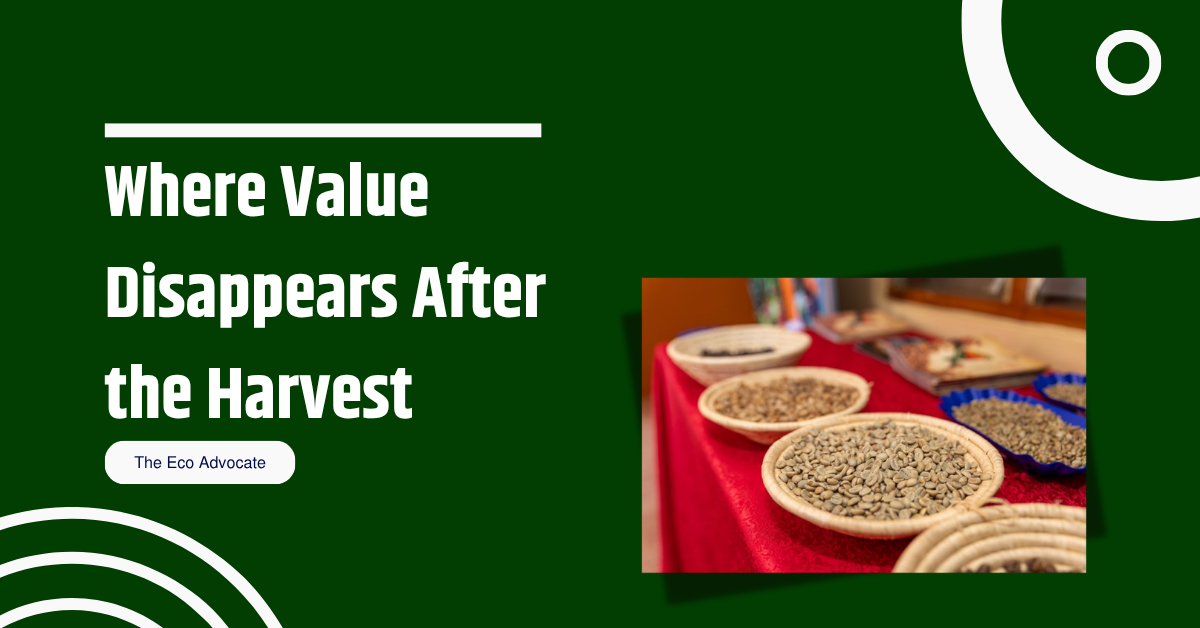
Where does value actually disappear in African food systems?
If you asked most people, they would point at the field. Poor seed. Failed rains. Pests. And yes, those are real. But the longer I report on farming, the more I think we are looking in the wrong place. The value is not usually lost in the field. It is almost always lost after it.
Think about it. A farmer grows a good crop. Then it sits in a store with no proper drying, waits for a lorry on a bad road, gets sold raw to a broker at the farm gate, and travels hundreds of kilometres to be processed somewhere else. By the time it reaches a shop shelf as a finished product, most of the money has moved to people who never touched the soil.
Over the past year or so, I have visited or reported on four very different places. A dryland ranch. A beef farm. An investor mission to Rwanda. A trade mission to the Democratic Republic of Congo. Different crops, different countries, different scales. And the same lesson kept coming back.
Four places, one pattern
Izera Ranch, Taita Taveta. Izera spans 20,000 acres of drylands. It started 16 years ago as a refuge for livestock escaping drought in Kajiado. Today it runs structured grazing fields, solar-powered boreholes that water both cattle and wildlife, and around 2,000 cattle, and it employs about 100 local people. Land restoration, livestock and community wellbeing are built into one system. What struck me most: restoring degraded land turned out to be a business decision, not just an environmental one.
Ongole Beef Farm, Rumuruti, Laikipia. Philip Kimeru runs a cattle operation of more than 2,000 head. But the story isn’t the size of the herd. It’s the value of each animal. A kilo of steak sold locally fetches around KSh 800. In a premium market, the same kilo can fetch KSh 6,000. Instead of complaining about that gap, the farm built across it, with its own slaughterhouse, cold storage and a retail outlet in Nairobi, plus organic feed and manure recycled back into its crops. The goal, in Kimeru’s words, is revenue multiplication per steer.
A Kenyan investor mission to Rwanda. In late 2025, a three-day trade mission in Kigali was organised by Equity Group, with over 300 participants from 30 countries. Seeing Rwanda up close held up a mirror to Kenya’s own gaps: post-harvest losses, dependence on rainfall, limited processing, and logistics bottlenecks. Inyange Industries showed how sourcing directly from smallholders, with guaranteed markets, steadies farmer incomes. DP World Kigali showed what fast, predictable logistics does for exports.
A trade mission to Lubumbashi, DRC. In September 2025, I reported on a five-day Equity Bank trade mission to Lubumbashi. Jambo Farming Company harvests about 22,000 tonnes of maize a year. Yet Jambo and two similar farms together meet only about 7% of Katanga’s maize demand. Food demand around the mining regions is rising fast, and local supply can’t keep up. Meanwhile, goods sent from Lubumbashi to Kinshasa travel about 2,300 kilometres, and that trip can take up to a month in the rainy season.
Four lessons from all four
1. Value beats volume. Farmers who capture value through grading, processing or better markets earn more from the same land. Ongole Beef didn’t get ahead by adding more cattle. It got ahead by earning more from each one. The gap between KSh 800 and KSh 6,000 a kilo is not a farming problem. It’s a value-chain problem.
2. Logistics and processing decide who keeps the margin. Cold chain, roads and storage matter as much as seed. A month-long road trip across the DRC, power cuts at a bottling plant, a maize harvest with nowhere to be processed nearby: each one hands the margin to someone further down the chain. Rwanda’s investment in a fast inland port shows the reverse is possible.
3. Land health is a business asset. Restoration and profitability aren’t opposites. Izera’s structured grazing and solar boreholes keep both cattle and land productive through dry years. Ongole’s organic feed and manure recycling cut input costs while building soil. Healthy land is not a cost centre. It is collateral for the future.
4. Community benefit is what makes it last. Systems that share gains survive shocks that extractive ones don’t. Izera employs around 100 local people. Inyange buys directly from smallholders on stable terms. And where pastoralists sell into a bigger operation, the fairness of those terms decides whether the model lifts a community or just extracts from it more efficiently. I asked that question about Laikipia in May, and I’m still asking it.
One more thread runs through three of these four stories: finance. Equity Bank organised the Rwanda and DRC missions and has shown interest in both Izera and Ongole. Serious agricultural lending matters. But the real test is whether it reaches the smallholder and the pastoralist woman, not only the large, integrated operations that already look bankable.
Fix what happens after the harvest
World Food Day’s theme this year is “Innovate today. Nourish tomorrow.” When we hear “innovation”, we picture a new seed, a drone or an app. Those have their place. But the innovation that matters most may not be a new technology at all. It might be fixing what happens after the harvest: the drying, the storage, the road, the processing plant, and the deal the farmer signs.
It’s the same principle I see in a school’s drip-bucket garden, just at a bigger scale. The innovation that lasts is the one people can afford, fix and own.
Which of these four patterns have you seen play out where you work? Tell me in the comments. I’m especially keen to hear from farmers, processors and transporters, because you see the gaps that reports miss.


Discover more from The Eco Advocate
Subscribe to get the latest posts sent to your email.


