
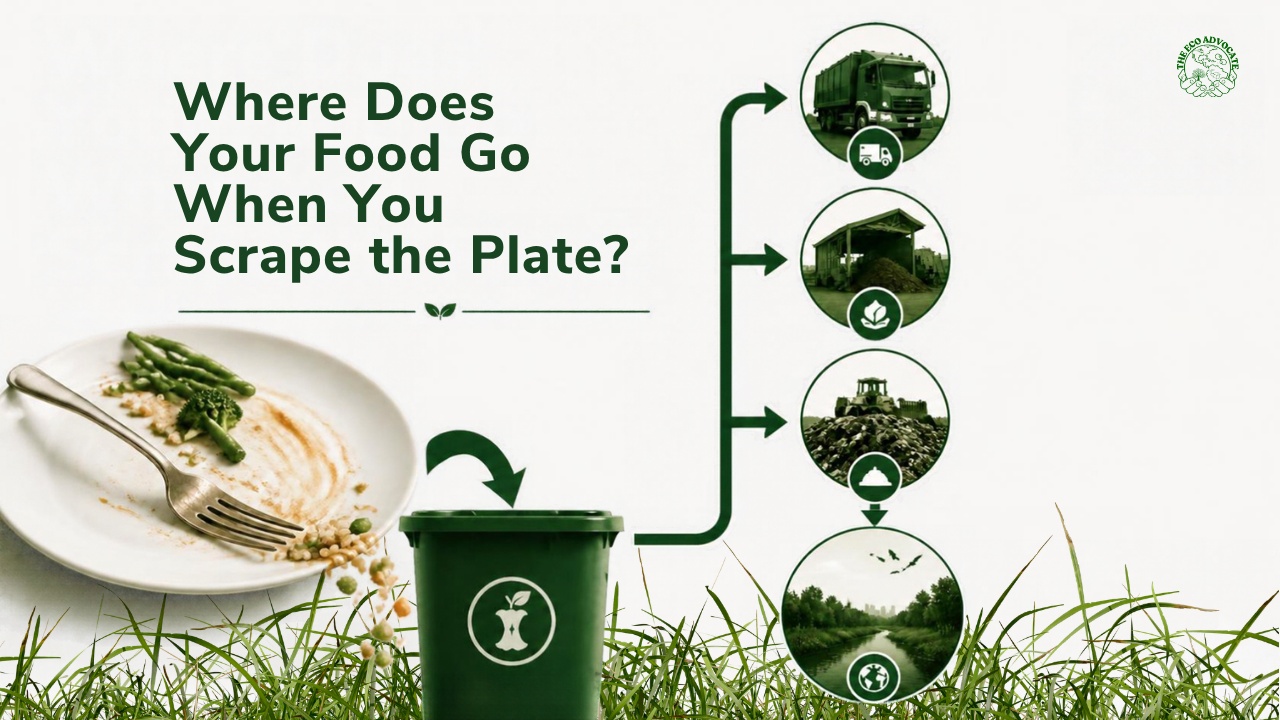
Do you know what happens to the food you scrape into the bin tonight? Do you know how much of Kenya’s food never even makes it to a plate?
Let’s talk about it.
Around the world, roughly a third of all food is lost or wasted. The UN breaks it down like this: about 13% of the world’s food is lost in the supply chain, between harvest and the shops. Then about 19% of the food that reaches us is thrown away in homes, restaurants and shops. In 2022 alone, that waste added up to 1.05 billion tonnes. And most of it, about 60%, came from households. From kitchens like yours and mine.
What about here at home? Studies on Kenyan household food waste put it at between 40 and 100 kilograms per person, every single year. One estimate puts the cost of food loss and waste in Kenya at around Ksh 72 billion a year, in a country where so many families still go to bed hungry.
But here’s the part we rarely think about: the ending matters.
In a dumpsite, food scraps get buried under everything else, cut off from air. Without oxygen, they rot and release methane, a greenhouse gas that traps about 80 times more heat than carbon dioxide over its first 20 years in the atmosphere. On a compost heap, where air can reach it, that same banana peel breaks down without making methane. And what’s left behind? Soil.
Same scraps. Very different ending.
Last Tuesday, 29 September, the world marked the International Day of Awareness of Food Loss and Waste, led by the UN’s Food and Agriculture Organization (FAO) and the UN Environment Programme (UNEP). This was only its seventh year, and it’s quieter than most awareness days. But it touches every kitchen in the country. So let’s not let it pass with a single post. Let’s carry it into this week.
Where does it actually go?
In Nairobi, more than half of all the solid waste we throw away is organic, and most of that is food. Much of what gets collected ends up at Dandora, the country’s largest dumpsite. Dandora opened in 1975. It was declared full in 2001. It is still receiving waste today.
And not everything even makes it there. In many informal settlements with no waste collection, rubbish is dumped by the roadside, thrown into rivers or burnt.
A smaller share of our food waste takes a better road. Some is fed to animals. Some is composted. And some is sorted by community groups who are turning kitchen waste into fertiliser for urban farms and school gardens, including the kitchen gardens I work on. These groups are proof that “waste” is often just a resource in the wrong place.
Why does it matter beyond the smell?
Because every wasted meal wastes so much more than food.
Think about the sukuma wiki that wilted at the back of your fridge. Someone grew it. It needed water, land and labour. It was transported, sold and carried home. When it goes into the bin, all of that goes with it: the water, the land, the energy, the labour and the money.
Waste isn’t just what’s left on the plate. It’s everything that came before it.
And the climate pays too. UNEP estimates that food waste is responsible for up to 10% of global greenhouse gas emissions. That’s not a small leak. That’s a big one, and it starts in our homes.
The world has promised to halve food waste per person by 2030, under Sustainable Development Goal 12.3. That’s just four years away. So who is going to make that happen? Governments, yes. Farmers and shops, yes. But also you. And me.
What can you do this week?
You don’t need a big budget or a big garden. Start here:
- Plan three meals before you shop. Buy what you’ll actually cook, not what looks good on the shelf.
- Freeze what you won’t eat in time. Leftover stew, ripe bananas, extra bread. Your freezer is a pause button.
- Use the “ugly” vegetables first. A bent carrot tastes exactly like a straight one.
- Start a compost bucket. Kitchen scraps and dry leaves, nothing fancier. Keep it covered, give it air, and turn it now and then.
- Share the extra. A neighbour, a colleague, a friend. Don’t bin it.
Simple habits. Real impact.
None of this needs a policy change. It needs a habit. And habits start with one meal, one bucket, one decision at the bin.
To everyone already composting, freezing, or sharing: thank you. You’re doing conservation work in your own kitchen.
And to everyone else, what will you do differently with tonight’s leftovers?


Discover more from The Eco Advocate
Subscribe to get the latest posts sent to your email.


